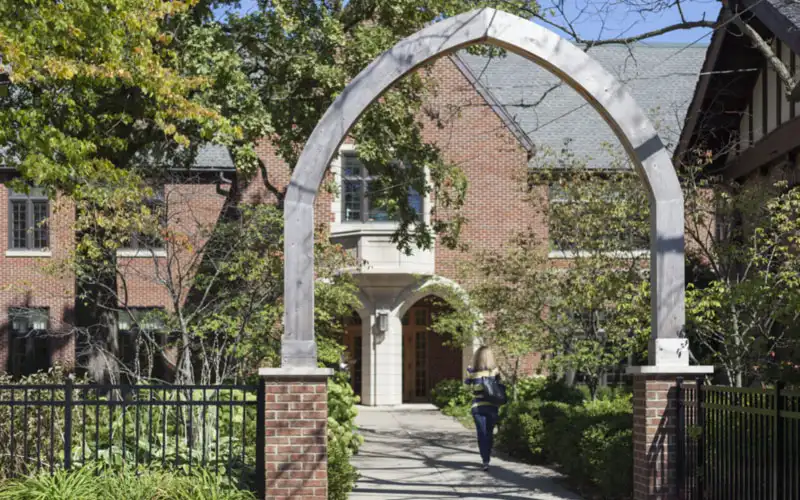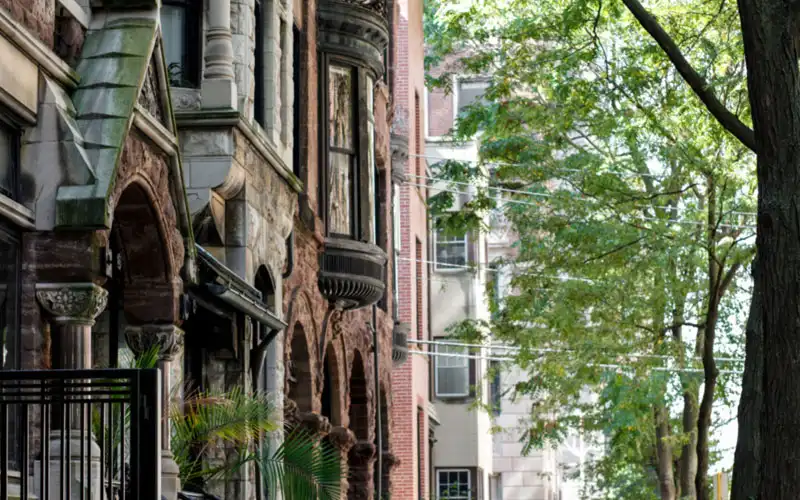

Buy inside a Lincoln Park landmark district and the city gets a say in two things: what the street can see, and whether the building can come down. It gets no say in your kitchen, your floor plan, your zoning or your tax rate. This guide covers which blocks are designated, what review looks like in practice, and how designation shows up in price.
Quick Facts
Six Chicago landmark districts sit inside Lincoln Park: Mid-North, Arlington-Deming, Armitage-Halsted, McCormick Row House, Fremont Row House and Bissell Street. Old Town Triangle covers the southern edge.
Sheffield is a National Register district, not a Chicago landmark district. No permit review, no protection against demolition.
Protection generally covers the exterior elevations visible from the sidewalk, plus demolition. Interiors are yours.
The Commission reviews roughly 2,000 landmark permits a year and approves most in a single day. Larger projects wait for a monthly meeting.
Designation does not change the assessor's valuation or your tax rate, and a qualifying rehab can freeze assessed value for eight years.
Which Lincoln Park Blocks Are Landmarked
Six Chicago landmark districts sit in Lincoln Park, covering a few hundred buildings inside a community area of roughly 68,000 people. Most of the neighborhood is not designated, which surprises nearly every buyer.
| District | Where it runs | Designated | What is there |
|---|---|---|---|
| Mid-North | Fullerton to Armitage, Lincoln Ave. to Clark | August 1977 | About 480 buildings, mostly brick row houses, plus pre-Fire wood cottages and two Louis Sullivan houses |
| Arlington-Deming | 2400-2500 blocks of Geneva Terrace and Orchard, 500-650 blocks of Arlington Pl. and Deming Pl. | September 2007 | About 124 buildings, from 1870s houses to 1920s apartment hotels |
| Armitage-Halsted | Armitage between Halsted and Racine, Halsted between Armitage and Webster | February 2003 | A 19th century commercial streetscape, heavy on pressed-metal bays, cornices and corner turrets |
| McCormick Row House | Between DePaul's east and west campuses | May 1971 | Queen Anne row houses built 1884 to 1889 around a private park |
| Fremont Row House | 2100 to 2144 N. Fremont St. | March 2004 | 1875 row houses by Edward Burling |
| Bissell Street | 2100 block of N. Bissell St., Webster to Dickens | September 2007 | A single intact block of post-Fire masonry houses |
Old Town Triangle, designated in September 1977, sits at the south end, straddling Lincoln Park and Near North.
How to check a specific address
The city's Chicago Landmarks database is the authority, and it is free. Search the address, and if it falls inside a district the record says so. Then pull that district's designation report, because it contains a building catalog listing every address as contributing or non-contributing.
Listing portals will not do this for you. Zillow, Redfin and Realtor.com pull from the MLS and public records, and neither reliably carries landmark status. A listing can call a house historic or vintage when the property carries no designation at all. Check the city database before you write an offer.
Separately, look the address up in the Chicago Historic Resources Survey, the citywide color-coded survey of pre-1940 buildings. A red or orange rating triggers a 90-day hold on any demolition permit, even outside a landmark district.
Sheffield Is a National Register District, Not a Chicago Landmark District
Sheffield has federal recognition and no local protection, and that gap costs Lincoln Park buildings every year. The Sheffield Historic District was listed on the National Register in 1976 and covers roughly 530 acres of western Lincoln Park, running from about Fullerton south toward Willow and from Lincoln and Larrabee west to Southport.
National Register listing is an honor and an eligibility ticket for certain tax programs. It requires no design review and does not stop a wrecking ball, which is why Landmarks Illinois named Sheffield to its most endangered list in 2019.
The current example is hard to miss. In 2026 DePaul University began clearing row homes and apartment buildings on N. Sheffield for a $50 million basketball practice facility, with demolition permits released in April once the delay period expired. Four small Chicago landmark districts sit inside Sheffield's footprint, so two houses a block apart can operate under completely different rules.
If an agent calls a Sheffield address landmarked, ask which ordinance. Usually the answer is none.
What Landmark Status Actually Means When You Buy
Landmark status in Chicago means the Commission reviews your building permit, and little more. There is no separate certificate, no extra permit, no parallel application. The Historic Preservation Division reviews permits inside the normal building permit process.
What gets reviewed is defined in each district's designation ordinance. For most Chicago landmark districts, the protected features are the exterior elevations visible from the public right of way, with demolition handled separately. Gut the interior, move the stairs, open up the kitchen, and none of that is the Commission's business as long as the street facade and the building itself survive.
Three limits matter.
Routine maintenance requires no permit at all. Painting and minor repairs sit outside the process entirely.
The Commission has no jurisdiction over zoning or use. It can recommend a reduced setback to protect a block's character, but it cannot grant you an extra floor.
Demolition of 40 percent or more of a designated building, or of a building in a landmark district, goes past the Commission to City Council, and the council committee has 75 days to act. That threshold is measured against the significant features named in the designation ordinance, so an aggressive gut rehab can land in the same bucket as a teardown.
One benefit rarely comes up. City permit fees are waived for permits requiring Commission approval, a change City Council made in 1997, though the application runs 90 to 120 days and has to be filed early.
What a Contributing Building Is, and Why It Decides Everything
A contributing building is one the Commission has determined carries the historic character the district was created to protect, and it receives the full weight of the ordinance. A non-contributing building sits inside the same boundary and receives very little. The designation ordinance and its building catalog identify which is which, address by address, and disputed buildings get tested against six criteria in the Landmarks Ordinance covering age, style, scale, materials, integrity and whether alterations can be reversed.
The Cenacle Sisters property is the clearest local illustration. The 1967 modernist retreat center at 513 W. Fullerton, designed by Charles Pope, stood inside the Mid-North District, and in June 2021 the Commission approved its demolition after finding it non-contributing. The reasoning was specific: the district's ordinance describes Italianate, Queen Anne and Romanesque Revival houses from the 1870s onward, and a seven-story complex using brick as decorative veneer did not match on scale or material. The site is now houses, two-flats and condominiums.
So on a tour, contributing status is the first question, not the last. It decides whether a third floor is possible, whether a rear addition is realistic, and whether the seller's "no restrictions here" is accurate.
How Long Chicago Landmark Permit Review Takes
Most landmark permits in Chicago clear in one business day. The Commission reviews roughly 2,000 permit applications a year for landmark properties, and the Department of Planning and Development sets a one-day review goal it aims to meet at least 95 percent of the time. Tuckpointing, roof work, a rear deck and mechanical replacements typically move at staff level without reaching a public meeting.
The slower track is real. New infill construction, additions and demolitions requiring council review go to the Commission at a public meeting, and the Commission meets on the first Thursday of the month. Miss a submission window or come back for revisions and you have lost a month per round. Budget two to three months for a project of that size.
The fix is a pre-permit submission. Staff will tell you what passes before you spend money on stamped drawings, and if a purchase depends on a specific renovation, make that call during attorney review.
Can you replace windows in a Chicago landmark district
Yes, though on street-facing elevations the replacements have to match the originals in profile, muntin pattern, sightlines and operation. Repairing sound original sashes is the preferred outcome, and interior or exterior storm panels solve heat loss without changing the appearance. Aluminum-clad wood and quality fiberglass are often workable. Vinyl frequently is not, because the profiles read wrong from the sidewalk. Rear and alley elevations get more flexibility.
One trap: a like-for-like window swap in an existing opening normally skips a building permit in Chicago, and that exception does not apply to landmark properties. Ask the seller for prior approvals and permit history.
Greystones, Masonry and What Renovation Actually Costs
A Lincoln Park greystone is a limestone-fronted row house or two-flat, most built between roughly 1890 and 1930 and faced in Bedford or Salem limestone quarried in south-central Indiana. Somewhere around 30,000 survive citywide. The stone is remarkably durable; what fails is the mortar, and the damage usually traces back to a previous owner's repointing done with a mix too hard for the stone.
That matters more than landmark status does. Review adds documentation and mortar-matching requirements; it does not create the underlying problem. Chicago masonry contractors price tuckpointing on a Lincoln Park greystone at roughly $14 to $28 per square foot, above common brick because the work is slower and hand-tooled (312 Masonry). Local builders put full greystone renovation at $150 to $400 per square foot, with gut projects on a 2,500 to 3,500 square foot house landing between $250,000 and $600,000. Treat those as planning ranges, not quotes.
On a greystone under contract, bring a masonry restoration contractor to the inspection alongside your general inspector and price the facade as its own line item.
Deming Place, Arlington Place and What Buyers Pay There
The Arlington-Deming District is the most house-driven of Lincoln Park's landmark districts and the one buyers ask about most. Curved Deming Place collected mansions after Lake View was annexed to Chicago in 1889, among them the Wieboldt house at 639 W. Deming, built in 1896 by Robert C. Berlin for the department store family. Arlington Place runs a block south with row houses and the 1928 Arlington House at 610-620 W. Arlington by Edwin H. Clark. The designation report catalogs all of it, and the district exists only because neighbors organized after a cottage on Geneva Terrace and a hostel on Arlington were slated to come down.
For pricing, the closest reliable read is the 60614 zip code. Over the three months ending May 2026, the median sale price was $848,000, up 10.8 percent year over year, at $525 per square foot, up 19.9 percent, with homes going under contract in about 34 days and drawing six offers on average, per Redfin. That median blends condos, row houses and single-family homes, so read it as directional rather than as a landmark-district price. Single-family sales inside Arlington-Deming and Mid-North run well above it.
If you are asking which agencies work Deming and the blocks around it, the sharper question is which agent has closed inside a designated district and can name an address's contributing status without looking it up. It also helps to know how these blocks price against the rest of Lincoln Park.
Does Landmark Status Lower a Home's Value or Raise Your Taxes
No on both counts, based on the available evidence. A hedonic study of Chicago sales published in Economic Development Quarterly found landmark buildings and districts sold at a small premium, smaller for districts than for individually designated buildings, with measurable spillover benefits for neighbors. The Commission's own position matches: studies generally show no negative effect on value, and neither the Assessor's valuation nor the tax rate changes because of designation.
Cook County taxes follow their own machinery regardless. Residential property is assessed at 10 percent of market value, and Chicago was reassessed in 2024, lifting citywide assessed value to $50.8 billion and pushing the median residential tax bill up 16.7 percent to $4,457. None of that is landmark-specific.
Two incentives are worth checking before you renovate.
The Illinois Property Tax Assessment Freeze holds the assessed value of an owner-occupied historic residence at its pre-project level for eight years, then steps it back to market over four more. You have to spend more than 25 percent of the assessor's fair market value on approved work within 24 months. It covers contributing buildings in local landmark districts and in National Register districts, which puts Sheffield addresses back in play, and it does not transfer to the next owner.
The Cook County Class L incentive cuts the assessment level to 10 percent for ten years, then 15 and 20 percent, but it applies to commercial, industrial and multifamily landmark buildings, not a single-family house.
The rest of what makes these blocks expensive has nothing to do with preservation. Abraham Lincoln Elementary, the K-8 school serving much of Mid-North and Arlington-Deming, enrolls roughly 850 students and carries a 9 out of 10 GreatSchools rating. The neighborhood posts a Walk Score of 94 and a bike score of 88, with Fullerton serving the Red, Brown and Purple lines.
Sources
Every figure in this article traces to the source below. Market data and tax figures carry a date because they change.
| Data point | Source |
|---|---|
| Lincoln Park landmark district boundaries and designation dates | Commission on Chicago Landmarks, Chicago Landmarks database. webapps1.chicago.gov/landmarksweb/web/generalinformation.htm |
| 90-day hold on demolition permits for red or orange rated buildings | Chicago Municipal Code, demolition delay provisions. codelibrary.amlegal.com/codes/chicago/latest/chicago_il/0-0-0-2661233 |
| Sheffield listed on the National Register in 1976, roughly 530 acres | Landmarks Illinois, Sheffield District. landmarks.org/wp-content/uploads/2019/05/Sheffield-District-FINAL.pdf |
| DePaul demolition permits released April 2026, $50 million facility | Preservation Chicago. preservationchicago.org/90-day-demolition-delay-2316-n-sheffield-avenue-lincoln-park-3/ |
| Roughly 2,000 landmark permits reviewed a year, one-day review goal met at least 95 percent of the time | City of Chicago, Historic Preservation Division permit review. chicago.gov/city/en/depts/dcd/provdrs/hist/svcs/permit_review.html |
| Demolition of 40 percent or more triggers City Council review, 75-day committee window | Chicago Municipal Code, landmarks ordinance. codelibrary.amlegal.com/codes/chicago/latest/chicago_il/0-0-0-2603413 |
| Permit fees waived for Commission-approved work, 90 to 120 day waiver processing | City of Chicago, permit fee waiver form. chicago.gov/content/dam/city/depts/zlup/Historic_Preservation/Publications/Permit_Fee_Waiver_Form_2020.pdf |
| Cenacle Sisters demolition approved June 2021 after a non-contributing finding | Chicago YIMBY. chicagoyimby.com/2021/06/landmarks-commission-approves-demolition-of-cenacle-convent-at-513-w-fullerton-avenue-in-lincoln-park.html |
| Commission on Chicago Landmarks meets the first Thursday of each month | City of Chicago. chicago.gov/city/en/depts/dcd/supp_info/landmarks_commission.html |
| Greystone tuckpointing at roughly $14 to $28 per square foot | 312 Masonry. 312masonry.com/cost/ |
| 60614 median sale price $848,000, up 10.8 percent, $525 per square foot, 34 days, six offers | Redfin, three months ending May 2026. redfin.com/zipcode/60614/housing-market |
| Designated properties and landmark districts sold at a small premium, with spillover to neighbours | Economic Development Quarterly, 2007. ideas.repec.org/a/sae/ecdequ/v21y2007i1p17-33.html |
| Chicago reassessed in 2024, citywide assessed value $50.8 billion, median residential bill up 16.7 percent to $4,457 | Cook County Assessor's Office. cookcountyassessoril.gov/Chicago2024 |
| Illinois assessment freeze, eight years plus a four-year step-up, 25 percent spend threshold within 24 months | Illinois State Historic Preservation Office. dnrhistoric.illinois.gov/preserve/taxfreeze.html |
| Class L assessment levels of 10, 15 and 20 percent, eligible property types | City of Chicago, Class L incentive. chicago.gov/city/en/depts/dcd/provdrs/hist/svcs/class_l_propertytaxincentive.html |
| Abraham Lincoln Elementary enrollment and 9 out of 10 rating | GreatSchools. greatschools.org/illinois/chicago/1200-Lincoln-Elementary-School/ |
| Lincoln Park Walk Score of 94 and bike score of 88 | Walk Score. walkscore.com/IL/Chicago/Lincoln_Park |