

Homes for Sale in Southport Corridor Chicago | Inside Lakeview
Lakeview's village within a village: eight blocks of independent shops and restaurants along Southport Avenue, tree-lined residential streets of greystones and two-flats behind them, a 1929 movie palace, a Brown Line stop at the corner, and Wrigley Field three blocks east.


The Southport Corridor is a sub-neighborhood of Lakeview on Chicago's North Side, centered on Southport Avenue between Belmont Avenue to the south and Irving Park Road to the north, with the residential blocks running east toward Clark Street and west toward Ashland or Ravenswood Avenue depending on whose definition you use. It is not an official City of Chicago community area and it has no fixed boundary. Lakeview is the community area, Community Area 6, and at 103,050 residents in the 2020 Census it is the second largest in the city. What the corridor has instead of a boundary is a character: a genuinely independent commercial street lined with low-rise storefronts, and behind it a grid of Victorian frame houses, early twentieth-century greystones, and brick two-flats. It was a quiet stretch of West Lakeview until the 1990s, when Southport Avenue began attracting independent retail, and it has since become one of the most consistently expensive residential pockets in Chicago.
The most useful number on this page is not a neighborhood median, it is the gap between two of them. Using Midwest Real Estate Data figures, @properties Christie's International Real Estate reported a Southport Corridor median sale price of $2.225 million for single-family homes against $695,000 for condominiums and townhomes, with homes selling in an average of 28 days and a median price per square foot of $414 across all residential types, compared with $199 across the MLS as a whole. Months' supply of inventory has run under two months for more than two years, where four to six months is considered balanced. Other trackers put the all-types median between about $760,000 and $909,000 and single-family houses between $1 million and $2.2 million, and one subdivision-level tracker recorded a single month where the median rose 124.8 percent on half the usual volume. That volatility is not a market signal, it is arithmetic: the corridor closes roughly nine to fifteen homes a month, so one large sale moves the median. Read the two product medians, not the blended one.
What makes the corridor distinctive among Chicago's premium markets is that it delivers a walkable independent retail street, a top-rated attendance-area elementary school, and genuine single-family housing in the same eight blocks, without the density of Lincoln Park or the game-day intensity of Wrigleyville. The housing stock reflects three eras: pre-1900 frame and Victorian houses, greystones and brick two-flats from roughly 1900 to 1930, and a steady stream of gut rehabs and new-construction single-family homes replacing or reworking the two-flats. Condominium supply comes mostly from those two-flat and three-flat conversions plus a small number of loft and mid-rise buildings, including the 1920 Cinema Lofts on West Belmont and the former postcard factory at 1733 West Irving Park Road. There is very little large-scale new condominium construction, which is why supply stays tight and why the buildings that do exist trade on their own comparables rather than a neighborhood average.
Carrie McCormick has sold Chicago real estate since 1999, has closed more than $3.5 billion in career sales, and lists the Southport Corridor among her core markets alongside the Gold Coast, Lincoln Park, and Lakeview. She is ranked in the top 1 percent of brokers by the Chicago Association of Realtors, holds the association's Gold and Platinum awards, and is the recurring luxury real estate expert on NBC 5 Chicago's Emmy-nominated series Open House Chicago. This is a market where a few hundred feet changes the answer. Which side of the Blaine Elementary attendance line an address falls on affects both the buyer pool and the price. A block south of Roscoe behaves differently from a block north of Addison. A two-flat conversion priced against new construction will sit, and new construction priced against a conversion leaves money behind. Whether you are buying a first condominium on Southport, trading up to a greystone, or selling a house that needs to be positioned against the four or five genuinely comparable sales rather than a median that spans $695,000 to $2.2 million, call 312-961-4612.
Southport Avenue is one of the few Chicago commercial strips where independent boutiques still outnumber chains, running roughly eight blocks with wide sidewalks and low-rise storefronts. Local names such as Alice and Wonder and Krista K sit alongside national tenants, and the scale is deliberately village-like rather than mall-like.
James G. Blaine Elementary at 1420 W. Grace Street is a Chicago Public Schools neighborhood school, not a magnet families apply to, with an A-minus from Niche and a 9 out of 10 from GreatSchools. Families inside the attendance boundary enrol automatically. That combination of quality and access by address is rare in Chicago and it is a measurable component of house prices here.
The Music Box opened at 3733 N. Southport Avenue on 22 August 1929, two months before the Crash, and has run as an art-house and repertory cinema since 1983. It keeps a 748-seat main house with a twinkling star ceiling, weekend organ music, and annual traditions including the Music Box of Horrors in October and the Music Box Christmas Sing-A-Long and Double Feature, which has run since 1983, from late November through December.
Southport Lanes, a 122-year-old tavern and hand-set bowling alley at 3325 N. Southport Avenue, closed in 2020. Boka Restaurant Group filled the building with three restaurants: Itoko from chef Gene Kato of Momotaro, GG's Chicken Shop from chef Lee Wolen, and Little Goat Diner, which Stephanie Izard relocated here from the West Loop.
The Southport station at 3411 N. Southport Avenue opened in 1907, was rebuilt in 2007 and 2008, is fully accessible, and carried more than 751,000 riders in 2025. It puts the Loop within a straightforward single-line ride, which is why the corridor draws commuters who want a house rather than a downtown condominium.
Wrigley Field is about three blocks east of Southport Avenue, which means walking to a game and back without living inside Wrigleyville's game-day footprint. It is the trade-off buyers here are consciously making, and it is worth understanding block by block rather than in general terms.
The Southport Corridor is small enough to walk end to end in twenty minutes, which means buyers navigate it by cross street rather than by sub-neighborhood name. Six stretches behave differently on price, noise, housing type, and school access, and the differences are large enough to matter on a single offer. Ranges below reflect typical recent activity and are a general guide rather than a valuation.


The corridor's restaurants are concentrated on eight walkable blocks of Southport Avenue, and the mix runs from destination dining to the kind of everyday places a neighborhood actually uses.
Coda di Volpe at 3335 N. Southport Avenue is the corridor's best-known room, a Southern Italian kitchen built around a wood-fired oven, Neapolitan pizzas, and hand-made pasta, and it appears in the Michelin Guide listings.
The former Southport Lanes building at 3325 N. Southport now holds three Boka Restaurant Group restaurants: Itoko, a Japanese room from chef Gene Kato of Momotaro; GG's Chicken Shop, a counter-service rotisserie and fried chicken spot from Boka chef Lee Wolen that is listed in the Michelin Guide; and Little Goat Diner, Stephanie Izard's all-day diner, relocated here from the West Loop.
Tied House at 3157 N. Southport is the neighborhood's contemporary American room, attached to Schubas Tavern, and Crosby's Kitchen at 3455 N. Southport is the family brunch and comfort-food default.
Southport Grocery and Cafe at 3552 N. Southport has anchored the everyday end for years, Steingold's of Chicago brought its Jewish deli and New York bagels to 3737 N. Southport in 2021, Dona Tola at 3751 N. Southport covers Mexican, and Brou'ne at 3721 N. Southport handles coffee and baked goods.

Southport Avenue is one of the last Chicago commercial streets where independent retail still sets the tone, and it is the corridor's defining asset rather than a convenience. Eight blocks of low-rise storefronts carry women's apparel, home goods, children's and gift retail, and specialty food, with long-standing local names such as Alice and Wonder and Krista K alongside national tenants including Anthropologie. The scale is what makes it work: wide sidewalks, street trees, no setbacks, and no mall. Buyers should know that turnover is real. The Foxtrot at 3334 N. Southport closed when that chain shut down in 2024, and Hotel Chocolat opened its Velvetiser Cafe in the 3,800 square foot space in April 2025. Colectivo Coffee opened at 3258 N. Southport in July 2026, in the former Schoolyard Tavern building, after a delay caused by a full rebuild of the south wall. Both are worth knowing as a pair: the street loses tenants and re-lets them quickly, which is a better signal for a buyer than either closure on its own. For groceries there is a Jewel-Osco within walking distance of most of the corridor, and the Low-Line Market runs seasonally in the space beneath the Brown Line embankment.
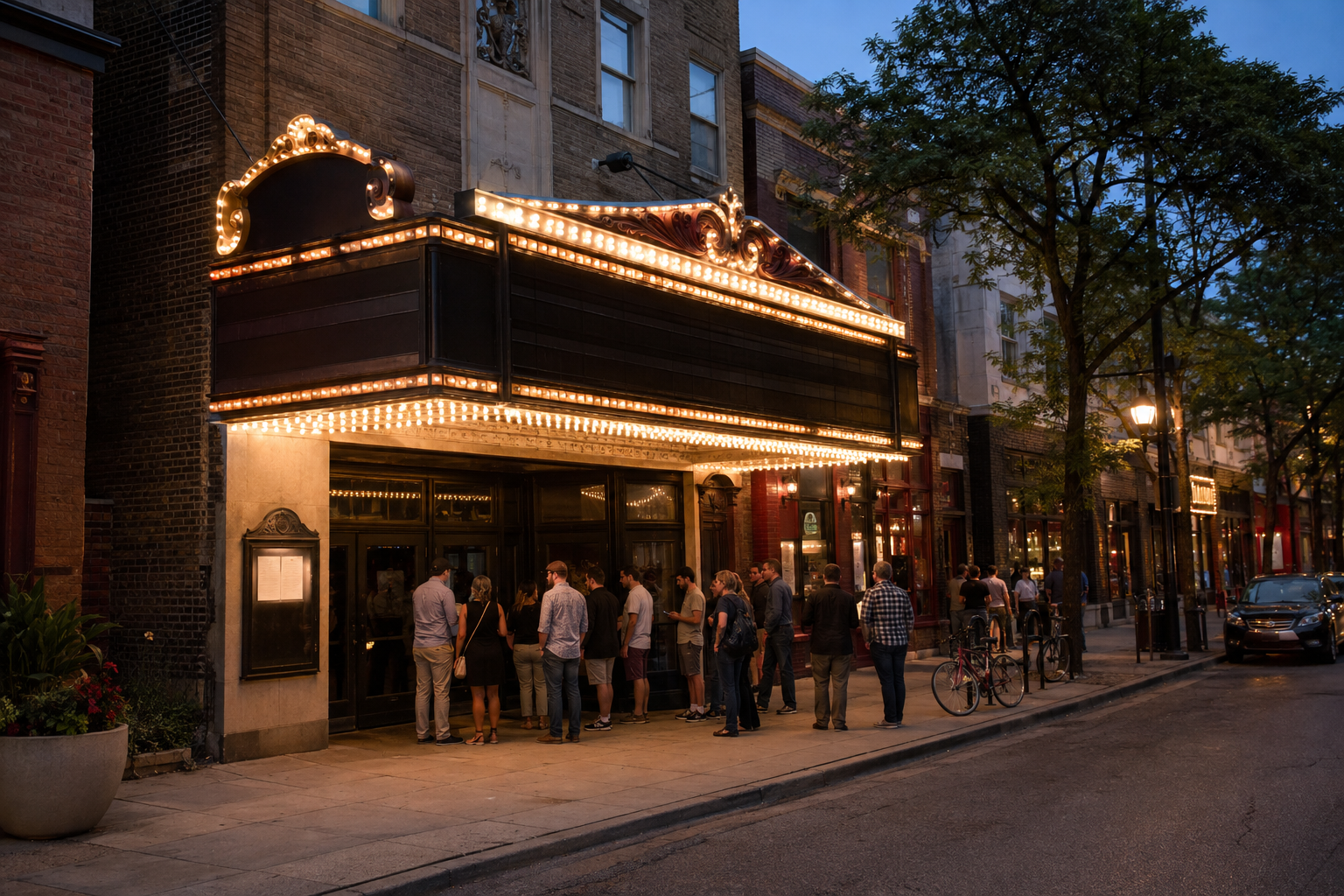
Green space is the corridor's main constraint, and buyers should hear that plainly. There is no large park inside it. Sheil Park at 3505 N. Southport Avenue is the neighborhood facility, with a fieldhouse, gym, and programming, and the corridor is within a short walk or ride of Hamlin Park to the west and the lakefront and Belmont Harbor to the east. What the corridor has instead is cultural density. The Music Box Theatre at 3733 N. Southport has run since 1929 and remains Chicago's leading art-house and repertory cinema, with a 748-seat main auditorium, a star-projected ceiling, weekend organ music, and annual traditions including the Music Box of Horrors each October and the Music Box Christmas Sing-A-Long and Double Feature through late November and December. The Mercury Theater on the same stretch programs live theater, and Schubas Tavern at Southport and Belmont has been a working music venue for over three decades. Wrigley Field, home of the Cubs, is about three blocks east. The corridor's own signature event is the Lakeview Taco Fest, which ran on Southport Avenue between Addison Street and Roscoe Street for its thirteenth year from 21 to 23 August 2026, with a competing field of around ten to fourteen restaurants, two music stages, and a $10 suggested donation, presented by the Lakeview Roscoe Village Chamber of Commerce.



The Southport Corridor is served by a single school district, Chicago Public Schools, formally City of Chicago School District 299. What makes the corridor unusual is that its attendance-area elementary school is itself a draw, which is true in relatively few Chicago neighborhoods and is one of the clearest price drivers on these blocks.
Blaine Elementary at 1420 W. Grace Street serves preschool through grade 8 and is the attendance-area school for much of the corridor. Chicago Public Schools describes it as a high-performing neighborhood school with the arts integrated across the curriculum, and it carries a fine arts magnet cluster designation, but the enrollment mechanism is the important part: families living inside the attendance boundary enrol automatically without applying, while families outside it must submit a Choice Elementary Schools application and go through a computerised lottery. Published figures give it an A-minus from Niche and a 9 out of 10 from GreatSchools, with enrollment reported between roughly 636 and 756 students and a student-teacher ratio between 13 and 15 to 1. Confirm the boundary for a specific address with CPS before relying on it, because the line does not follow the corridor's informal edges.
Buyers comparing schools online will find Blaine's state test results lower than its reputation and its other ratings suggest, with proficiency figures reported variously between 53 and 78 percent depending on source and year, and a U.S. News ranking around 124th among Illinois elementary schools. Part of the explanation is participation: Blaine parents have opted their children out of the state assessment in numbers large enough that community members have publicly raised the effect on the school's published scores. Those scores feed the real estate portals buyers read, so the gap between the published number and the school's standing in the neighborhood is worth explaining rather than ignoring. Ask the school directly about participation rates and internal assessment data.
Nearby Chicago Public Schools options include Hamilton Elementary and Burley Elementary, both of which serve parts of Lakeview and operate magnet cluster programs, and Lake View High School on North Ashland Avenue is the neighborhood high school. Families also compete for city-wide selective-enrollment high schools, which admit by test and tier rather than by address, so a Southport address gives no advantage at those. On the independent side, families in the corridor commonly look to schools in Lakeview, Lincoln Park, and North Center rather than inside the corridor itself, including the Latin School of Chicago and Francis W. Parker School to the south.
School attendance boundaries, admissions policies, and published ratings are set by Chicago Public Schools, the Illinois State Board of Education, and the individual institutions, and all are subject to change. Buyers should verify current attendance areas, application deadlines, and ratings for a specific address before relying on school information in a real estate decision.
Development accelerated with Potter Palmer's mansion in 1882.
Encompasses the historic core alongside the 60611 district.
Consisting of roughly 5,600 households averaging two people.
Historically one of America's wealthiest urban enclaves.
Neighborhood entry point, driven heavily by vintage condominium volume.
The current baseline for standard attached housing stock.
Set in 2017 by the purchase of the top four floors at No. 9 Walton.
The neighborhood's largest single source of high-rise inventory.
With a median asking price currently hovering near $585,000.
The average market pace alongside ~45 monthly closings.
Connected directly to the trail via Oak Street Beach.
Direct access via two CTA train stops and four major bus routes.
Navigating Chicago's Gold Coast luxury real estate market requires unparalleled expertise. Here is what you need to know before we begin.
Ask A QuestionAsk about the product type first, because the two markets here are more than three times apart. Using Midwest Real Estate Data figures, @properties Christie's International Real Estate reported a Southport Corridor median sale price of $2.225 million for single-family homes against $695,000 for condominiums and townhomes, with a median of $414 per square foot across all residential types compared with $199 across the MLS as a whole. Blended all-types medians from other trackers land between roughly $760,000 and $909,000, which tells you very little on its own. Monthly figures are especially unreliable here because the corridor closes only about nine to fifteen homes a month, so a single large house sale can move the median dramatically. Homes have been selling in an average of 28 days with under two months of supply.
It is inside Lakeview, and it has no official boundary. Lakeview is the City of Chicago community area, Community Area 6, with 103,050 residents at the 2020 Census. The Southport Corridor is a sub-neighborhood within it, most commonly defined as Southport Avenue between Belmont Avenue on the south and Irving Park Road on the north, with the residential blocks running east toward Clark Street and west toward Ashland or Ravenswood Avenue. Definitions vary: some sources start it at Addison rather than Belmont, and the eastern and western edges shift depending on who is drawing them. Because it is a sub-neighborhood rather than a community area, an address here is accurately described as both Southport Corridor and Lakeview, which is why the same home often appears under both names.
There is a specific obstacle worth knowing about. Chicago listings originate in Midwest Real Estate Data, the regional MLS, and MRED classifies homes here under Lakeview rather than Southport Corridor, because the corridor is not an MLS area. That means there is no official field to filter on, and the Southport Corridor tags used by national portals are approximations that routinely return Wrigleyville, Roscoe Village, and North Center addresses. Searching by ZIP code does not help either, since the corridor straddles 60613 and 60657 and both extend well beyond it. The reliable approach is to search by street and block range, or by the Blaine Elementary attendance area if schools are driving the decision, and then confirm the cross streets on anything that looks promising.
Three products, in roughly ascending price order. Condominiums, most of them created by converting brick two-flats and three-flats, plus a smaller number of loft and mid-rise buildings such as the 1920 Cinema Lofts on West Belmont and the former postcard factory on West Irving Park Road, generally carry the corridor's transaction volume and its more attainable pricing. Two-flats and three-flats sell both to owner-occupiers who want rental income and to buyers planning a single-family conversion. Single-family houses run from Victorian frame houses and early twentieth-century greystones through gut rehabs to new construction, and they set the top of the market. The blocks west of Southport toward Ashland hold the highest concentration of houses; the avenue itself is almost entirely attached.
The corridor is served by one district, Chicago Public Schools District 299, and its attendance-area elementary school is a genuine draw. Blaine Elementary at 1420 W. Grace Street serves preschool through grade 8, holds an A-minus from Niche and a 9 out of 10 from GreatSchools, and enrols families inside its attendance boundary automatically, with a lottery for those outside it. Note one quirk: Blaine's published state test scores read lower than its other ratings and its local reputation, and assessment participation is part of the explanation, so treat the portal numbers with care and ask the school directly. Lake View High School is the neighborhood high school, and city-wide selective-enrollment high schools admit by test and tier rather than by address. Confirm the Blaine boundary for a specific address with CPS before relying on it.
It has moved from a neighborhood-serving shopping street to one of Chicago's strongest urban village corridors, and the change is visible building by building. Southport Avenue began drawing independent retail in the 1990s and has since added national tenants alongside the local ones. The most significant recent change is the former Southport Lanes building at 3325 N. Southport, a 122-year-old tavern and hand-set bowling alley that closed in 2020 and now holds three Boka Restaurant Group restaurants: Itoko, GG's Chicken Shop, and Little Goat Diner, the last relocated from the West Loop. New mixed-use development continues, including a project at Southport and Addison replacing a former bank property with retail and apartments. On the residential side, the steady trend has been two-flats converting to single-family homes, which tightens condominium supply.
Manageable, and it is the reason many buyers choose Southport over Wrigleyville. Wrigley Field sits about three blocks east of Southport Avenue, close enough to walk to a game and home again, far enough that the corridor's residential blocks are not inside the ballpark's immediate footprint. The practical effects concentrate on the eastern edge toward Clark Street, where game-day parking restrictions, permit zones, and street closures are a real factor, and where rental and short-term occupancy are more common. West of Southport the effect drops off sharply. If quiet matters to you, walk the specific block on a game day before you make an offer, because the difference between two streets can be substantial.
Carrie McCormick has sold Chicago real estate since 1999, has closed more than $3.5 billion in career sales, and lists the Southport Corridor among her core markets. Under her "100 percent Carrie" model clients work directly with her from the first valuation through closing. In a corridor this small, that matters because the variables are granular: which side of the Blaine attendance line an address sits on, whether a two-flat conversion should be priced against new construction or against other conversions, how much a block's permit-parking zone and game-day exposure affect resale, and how to price a house against the four or five genuinely comparable sales rather than a median that spans $695,000 to $2.2 million. She is ranked in the top 1 percent of brokers by the Chicago Association of Realtors, holds the association's Gold and Platinum awards, is the recurring luxury real estate expert on NBC 5 Chicago's Open House Chicago, and works within the Christie's International Real Estate network. Call 312-961-4612.
Carrie McCormick has been selling Chicago real estate since 1999, with more than $3.5 billion in career sales and the Southport Corridor among her core markets. Her practice here spans the whole corridor, from condominiums above the shops on Southport Avenue and two-flats on the side streets to greystones and new-construction houses inside the Blaine attendance area. Ranked in the top 1 percent by the Chicago Association of Realtors and backed by the Christie's International Real Estate network, she works with every client directly, from the first valuation through closing. To talk through a purchase, a sale, or a relocation, call 312-961-4612 or email carrie@atproperties.com.