Homes for Sale in River North Chicago | Condos and Lofts
Chicago's densest downtown neighborhood: more than a hundred restaurants, the Merchandise Mart, Marina City, a riverfront on two sides, and a condominium market that runs from under $200,000 to over $6 million inside roughly one square mile.
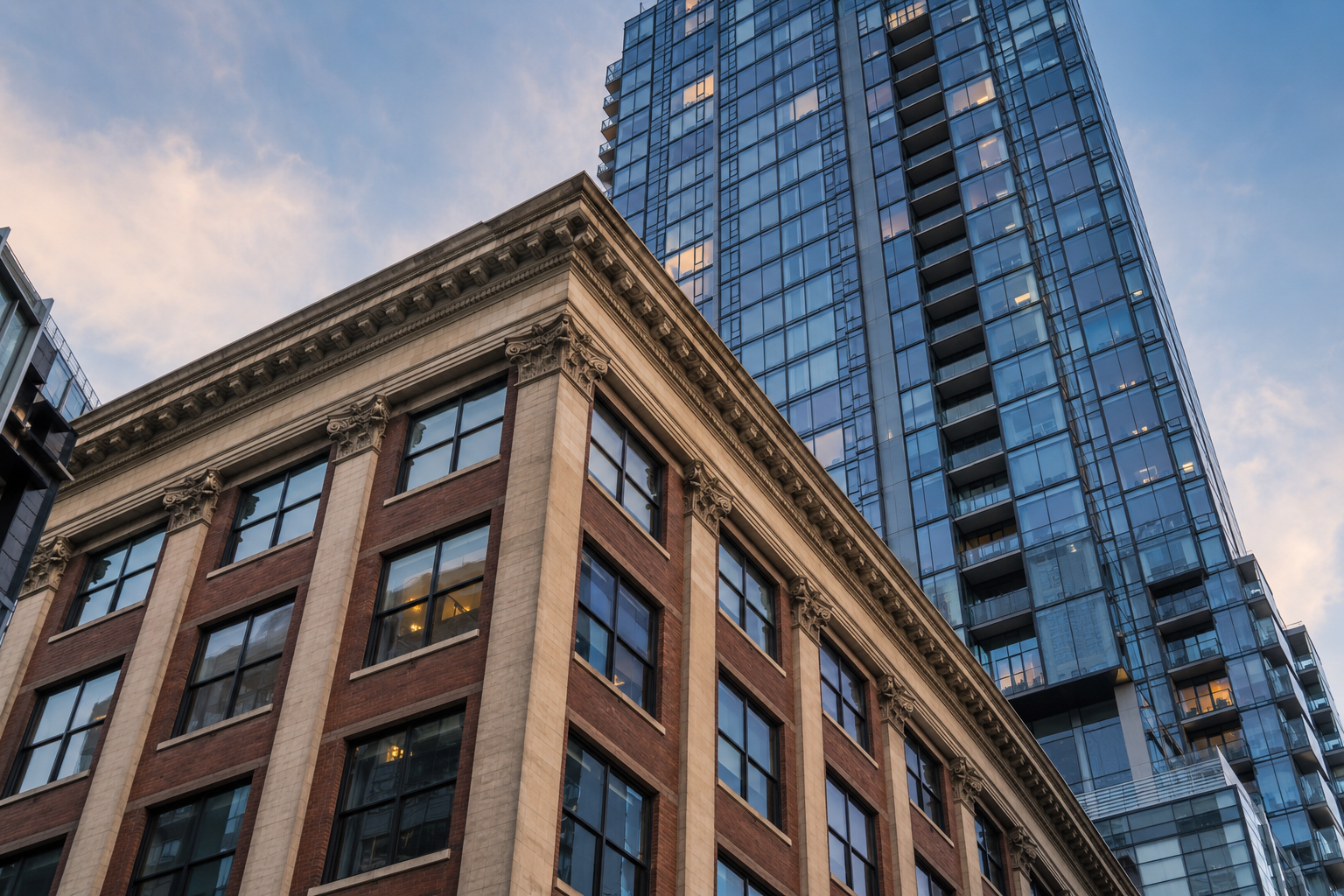
River North is the neighborhood directly north of the Chicago River's main branch, inside the Near North Side community area and immediately west of the Magnificent Mile. Its boundaries are contested on two sides. Most descriptions run the Chicago River along the south and west, with Chicago Avenue on the north and either Wabash Avenue, State Street, or Michigan Avenue on the east, while some sources push the northern edge up to Division Street. The area was industrial for most of its history and was called Smokey Hollow around the turn of the twentieth century for the coal smoke from its factories and forges. It also held Little Sicily and the city's first Italian Catholic parish, and the north bank of the river near the present Michigan Avenue Bridge is where Jean Baptiste Point du Sable established the first known permanent settlement in what became Chicago. The name River North is recent and commercial: the developer Albert Friedman began using it in 1974 while buying and restoring warehouse property in what was then a skid row, in order to make the area lettable.
This is the deepest condominium market in Chicago and, on recent readings, one of its slowest to sell in, though the picture has been firming. For the three months ending March 2026, Redfin reported a median sale price of about $426,750, essentially flat year on year at down 0.27 percent, at roughly $400 per square foot, up 1.8 percent, with 160 homes sold in March, about 71 days on market against 87 a year earlier, and a sale-to-list ratio of 98.9 percent. Other readings put the median near $400,000 for October 2025 with around 66 days on market, while a separate tracker reported a July 2026 median of $432,000 against an average sale price of $540,621 with roughly 294 condominiums listed, and Zillow's typical value sat in the low-to-mid $300,000s. Two things follow. First, buyers currently have negotiating room here that they do not have in Lincoln Park, North Center, or the Southport Corridor, where homes sell above list in under 40 days. Second, the neighborhood median is almost meaningless as a guide, because active listings have ranged from about $189,900 to $6,000,000 at the same time. Price by building, floor, and view, not by neighborhood.
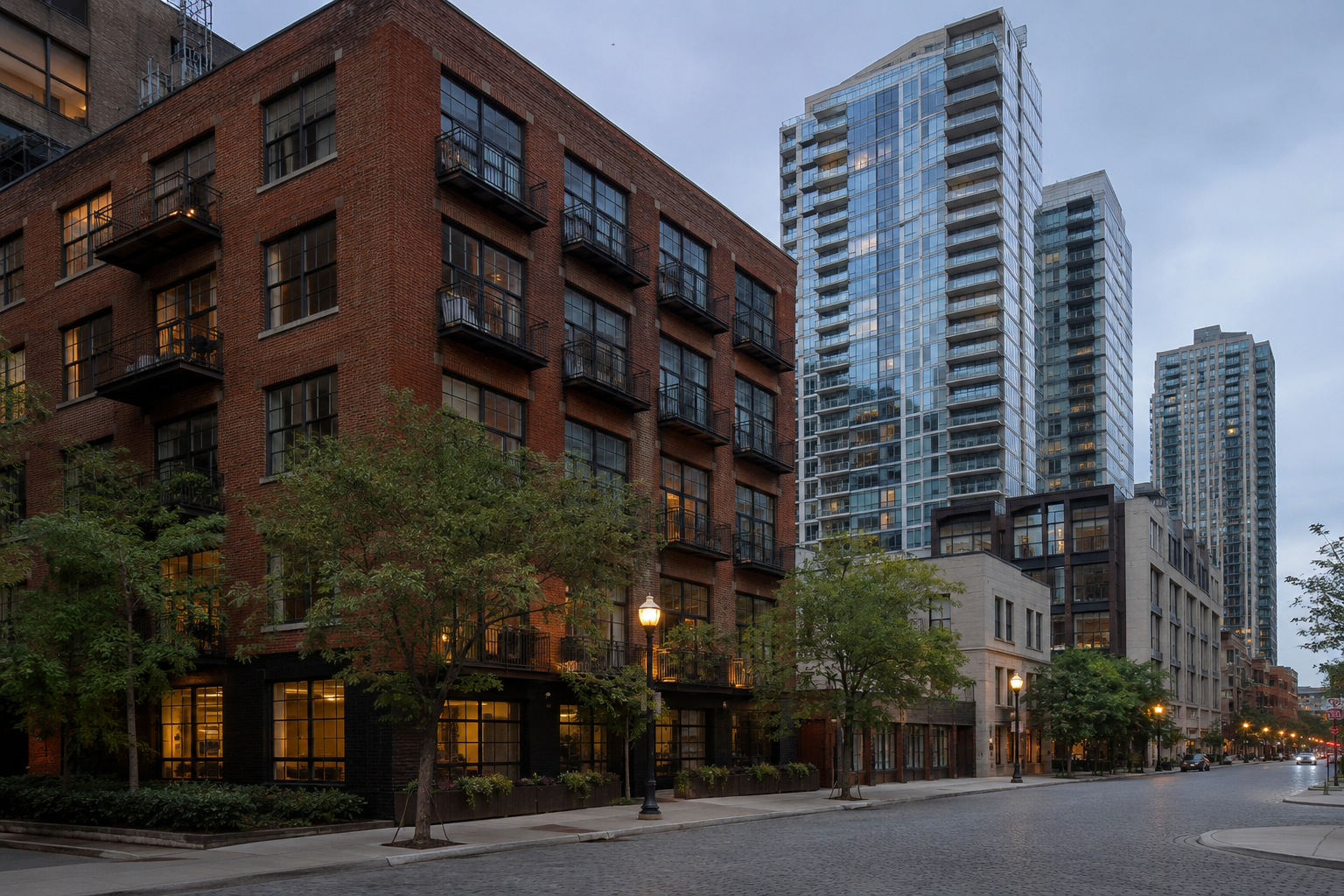
What buyers are actually choosing between here is a set of very different building types wearing the same neighborhood name. There are 1960s and 1970s landmarks such as Marina City, Bertrand Goldberg's twin corncob towers on the river. There are timber and masonry loft conversions in former warehouses and printing houses, mostly west of Clark and north of Kinzie. There are 1990s and 2000s condominium high-rises through the middle of the neighborhood. And there are newer luxury riverfront and Wabash Avenue towers at the top of the market. The variable that decides value between them is the monthly assessment: older loft conversions commonly run in the low hundreds while full-service luxury towers frequently exceed $1,000 a month, and two units at the same asking price can carry wildly different total costs. Reserves, assessment history, rental caps, and the owner-to-investor ratio matter here as much as the finishes do, and they are the most common reason a River North purchase disappoints.
Carrie McCormick has sold Chicago real estate since 1999, has closed more than $3.5 billion in career sales, and lists River North among her core markets alongside the Gold Coast, Lincoln Park, and Lakeview. She is ranked in the top 1 percent of brokers by the Chicago Association of Realtors, holds the association's Gold and Platinum awards, and is the recurring luxury real estate expert on NBC 5 Chicago's Emmy-nominated series Open House Chicago. In a market this building-driven and this soft, the work is not finding inventory, it is reading buildings: comparing reserve studies and assessment histories, knowing which associations have deferred facade or mechanical work, understanding which lines in a tower actually hold their value and which do not, and pricing a unit against the four or five genuinely comparable sales inside its own building rather than a neighborhood figure that spans thirty times its own range. Whether you are buying a first condominium, a river-facing high floor, or selling into a market where days on market run past sixty, call 312-961-4612.
River North carries well over a hundred restaurants in a compact, walkable area, from Gene and Georgetti, Chicago's oldest steakhouse, to Bavette's Bar and Boeuf, the Rick Bayless group at Michelin-starred Topolobampo, Frontera Grill, and Xoco, and Michelin-starred Indienne on West Huron. Very few residential neighborhoods anywhere offer this density at street level.
The Loop starts on the other side of the river, a five to fifteen minute walk from most of the neighborhood, and the Merchandise Mart, one of the largest commercial buildings in the world when it opened in 1930, sits inside it with offices, showrooms, and a tech hub. Four rail stations serve the area on the Brown, Purple, and Red lines.
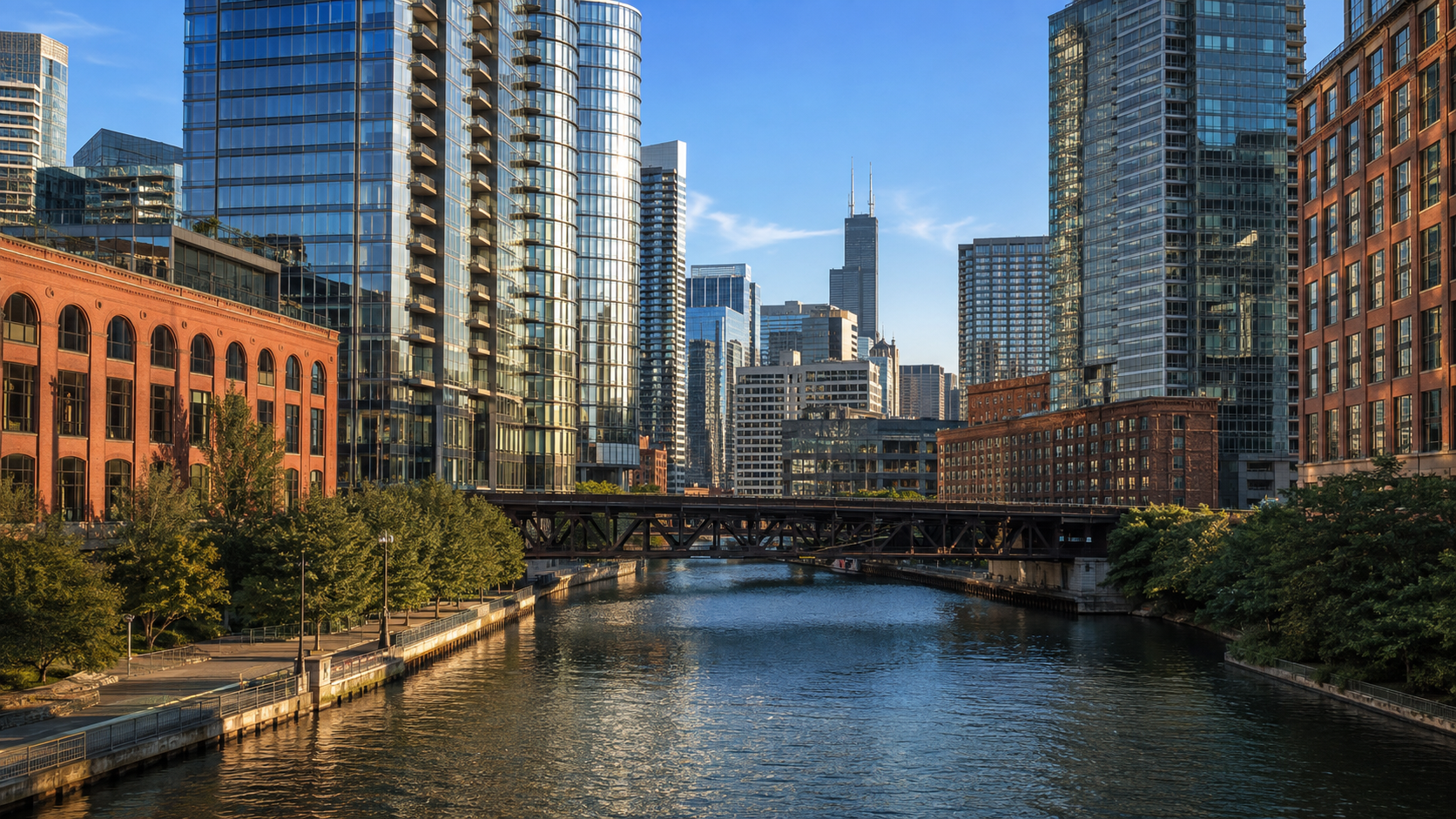
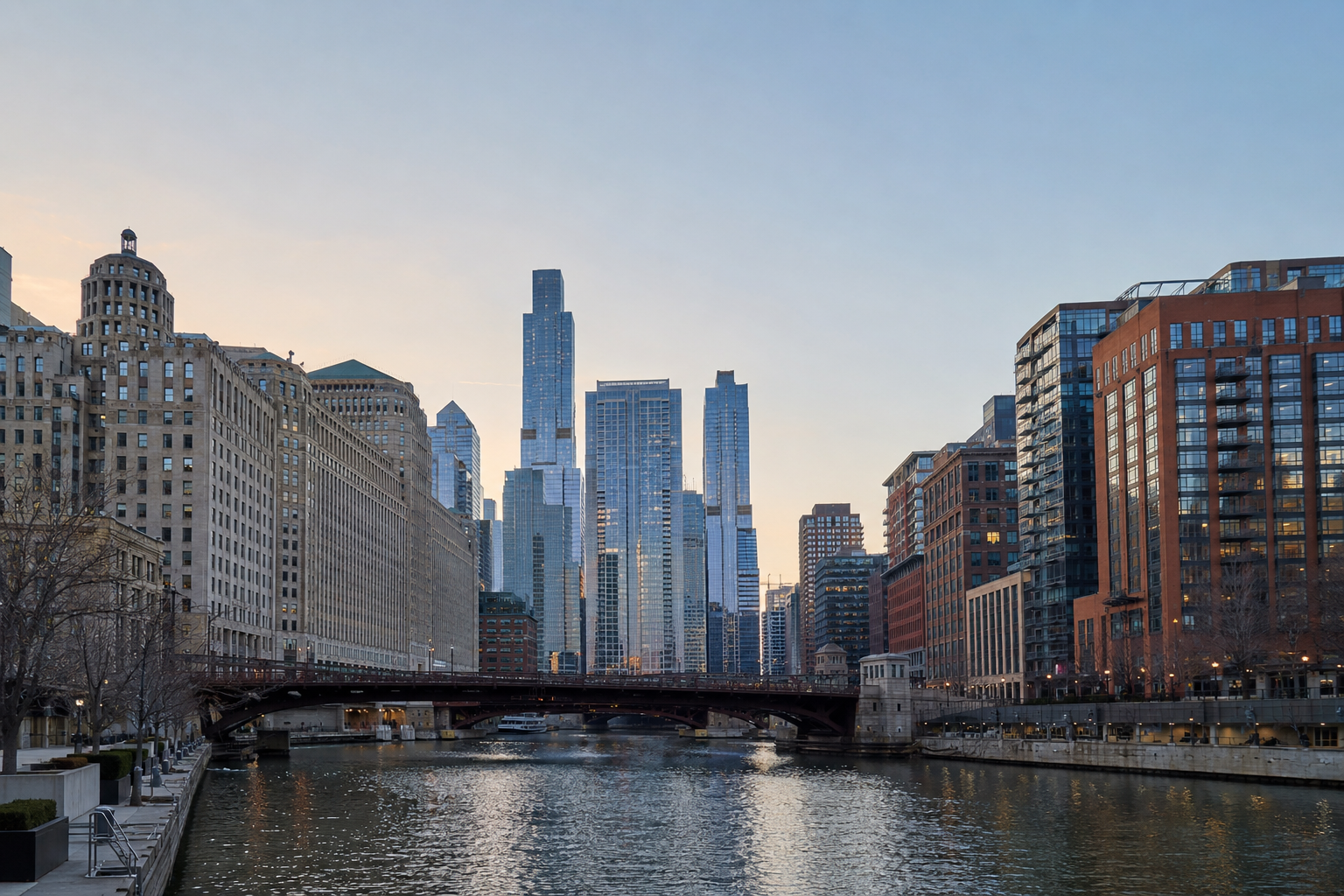
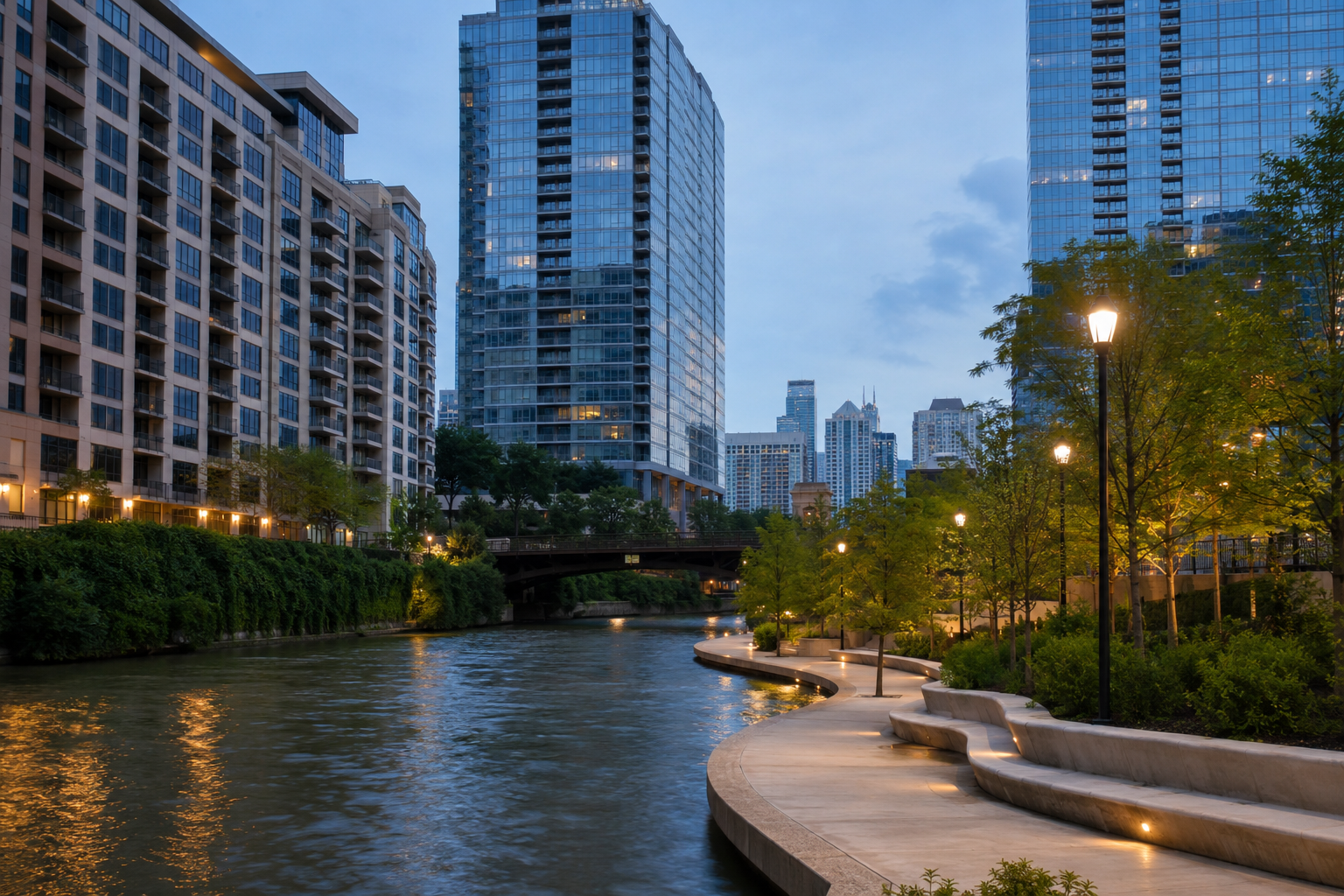
The Chicago River runs along both the southern and western edges, giving the neighborhood more water frontage than any other downtown residential area. The Chicago Riverwalk is directly across the main branch, and Montgomery Ward Park and Erie Park sit on the western bank among the Kingsbury Park towers.
Marina City's twin towers, designed by Bertrand Goldberg and completed in the 1960s, are among the most recognisable residential buildings in America and are individual condominiums you can actually buy. Around them sit landmark commercial buildings, warehouse conversions with heavy timber and masonry, and a run of contemporary riverfront towers.
Active listings have ranged from about $189,900 to $6,000,000 at the same time. That means a first-time buyer and a buyer at the top of the downtown market can both be served inside one neighborhood, which is unusual and is a genuine argument for River North over more uniform markets.
Recent readings showed the median essentially flat year on year, homes taking about 71 days to sell, and a sale-to-list ratio just under 99 percent, meaning the typical home still closes below asking. In a city where several North Side neighborhoods are still selling above asking in under 40 days, that is a meaningful difference and it favors buyers who are prepared.
River North is compact enough to walk across in twenty minutes and varied enough that the block and the building change the answer completely. Six areas behave differently on price, noise, building age, and assessment level. Ranges below reflect typical recent activity and are a general guide rather than a valuation.



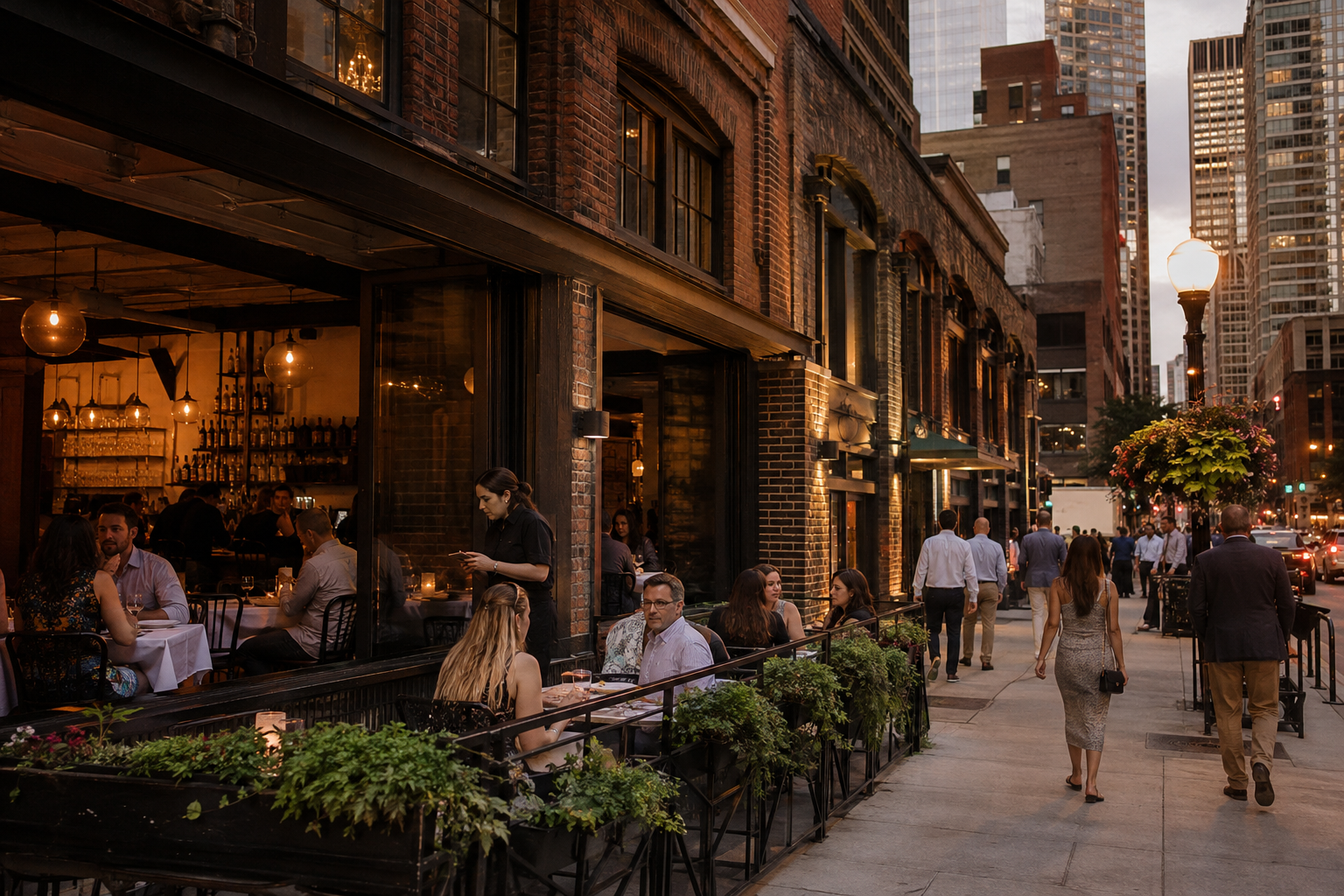
River North holds one of the densest concentrations of restaurants in the country, with well over a hundred in a compact area, and the range runs from century-old institutions to Michelin-starred rooms.
Gene and Georgetti at 500 N. Franklin Street is Chicago's oldest steakhouse, opened in the early 1940s by two Italian founders, which is why it serves as much Italian as it does steak.
Bavette's Bar and Boeuf on West Kinzie Street is the neighborhood's modern steakhouse benchmark, a dark, clubby room that is consistently ranked among the best restaurants downtown.
Rick Bayless operates Topolobampo, his Michelin-starred fine-dining Mexican room, and the more casual Frontera Grill side by side at 445 N. Clark Street, with Xoco, his quick-service room for tortas and hot chocolate, around the corner at 67 W. Illinois Street.
Indienne at 217 W. Huron Street holds a Michelin star awarded in 2023 for chef Sujan Sarkar's contemporary Indian cooking, and is described as the first Indian restaurant in the city to earn one.
Tzuco at 720 N. State Street is chef Carlos Gaytan's Mexican and French room, Siena Tavern on West Kinzie Street covers Italian from the DineAmic group, and RPM Italian and RPM Steak anchor the higher-volume end of the scene.
For something completely different, Mr. Beef on North Orleans Street is the Italian beef stand that inspired the television series The Bear.
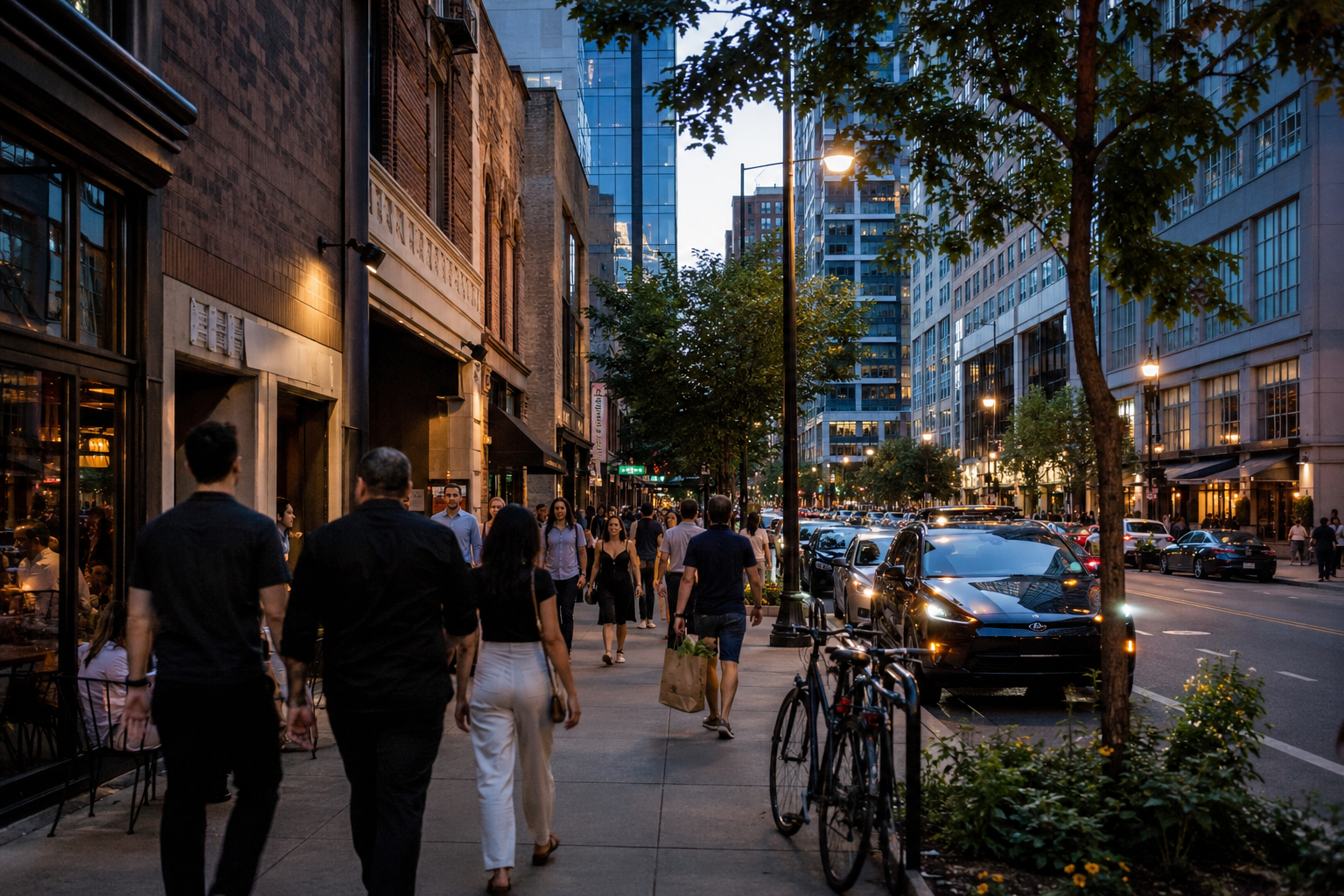
River North is Chicago's principal nightlife district, concentrated on and around Hubbard, Clark, and Ontario Streets, which is an asset for some buyers and a liability for others depending entirely on the block. Bally's has operated a temporary casino inside the landmark Medinah Temple at 600 N. Wabash Avenue since September 2023, with roughly 750 slot machines and 55 table games; its permanent $1.7 billion complex is being built in River West rather than River North, and its opening has slipped toward spring 2027. Legislation extending the temporary license passed in June 2026, moving the Medinah Temple expiry to 9 September 2027, so the temporary casino will remain in the neighborhood into 2027. For shopping, the Magnificent Mile begins at the eastern edge and the design showrooms run north of the Merchandise Mart, but River North is not a boutique retail neighborhood in the way the Gold Coast or Southport are. Everyday life is well served: multiple full-service grocery stores, the East Bank Club on the western edge, the Chicago Riverwalk directly across the main branch, and Montgomery Ward Park and Erie Park inside the neighborhood.
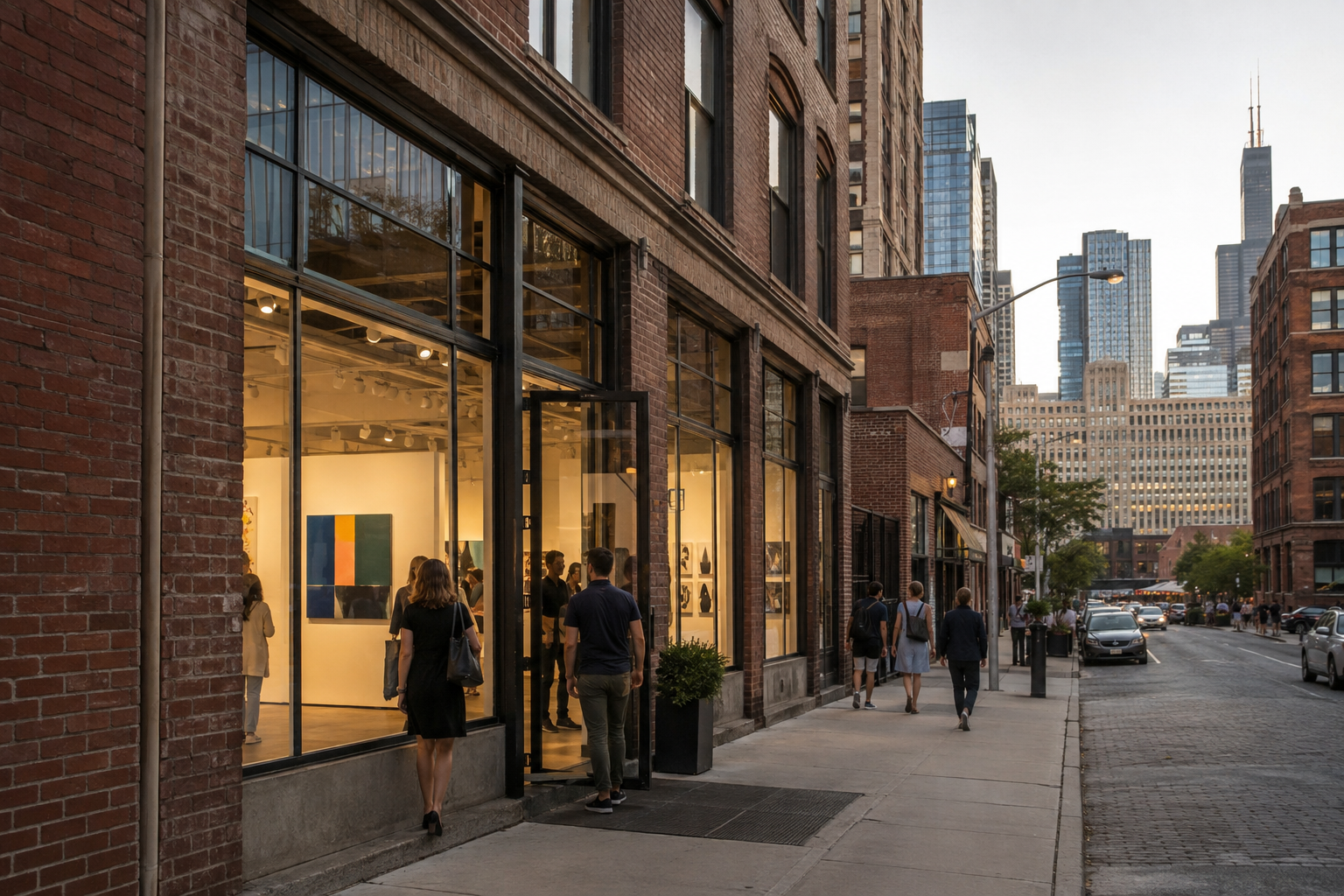
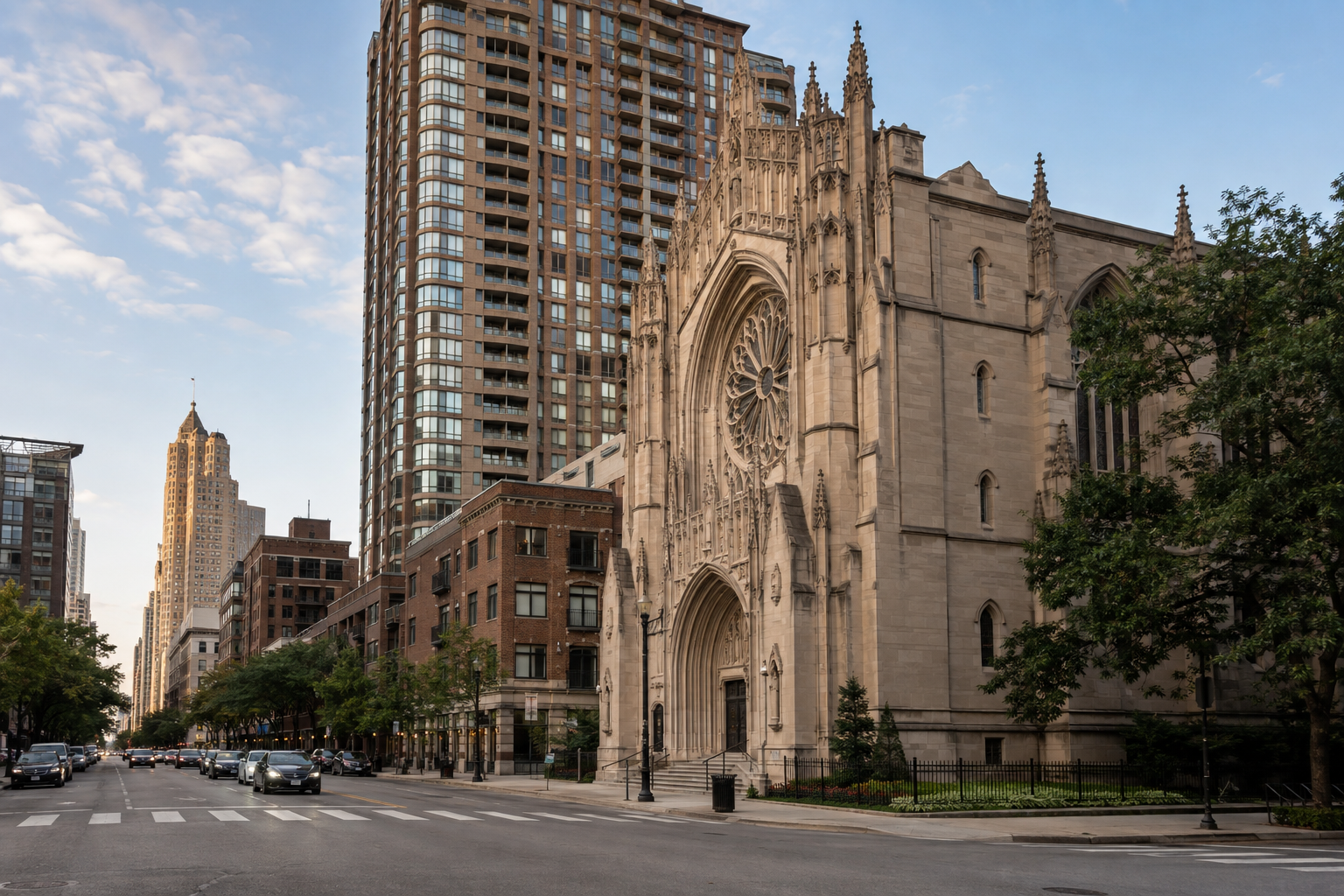
River North gave its name to what was, for two decades, the largest art gallery district in the United States outside Manhattan. That is no longer the case. After a fire destroyed a major gallery building and rents rose in the ones that remained, most galleries moved on, first to the West Loop and more recently to West Town, which is now Chicago's dominant gallery district. What survives in River North is still a real and walkable cluster of commercial galleries around Superior, Huron, and Franklin, including long-established rooms such as Zolla/Lieberman on West Huron, with organized gallery walks held through the year. Alongside them sit the Richard H. Driehaus Museum, a restored Gilded Age mansion on East Erie Street, the landmark Medinah Temple, Holy Name Cathedral at State and Superior, and Art on theMART, the seasonal projection onto the Merchandise Mart's river facade.
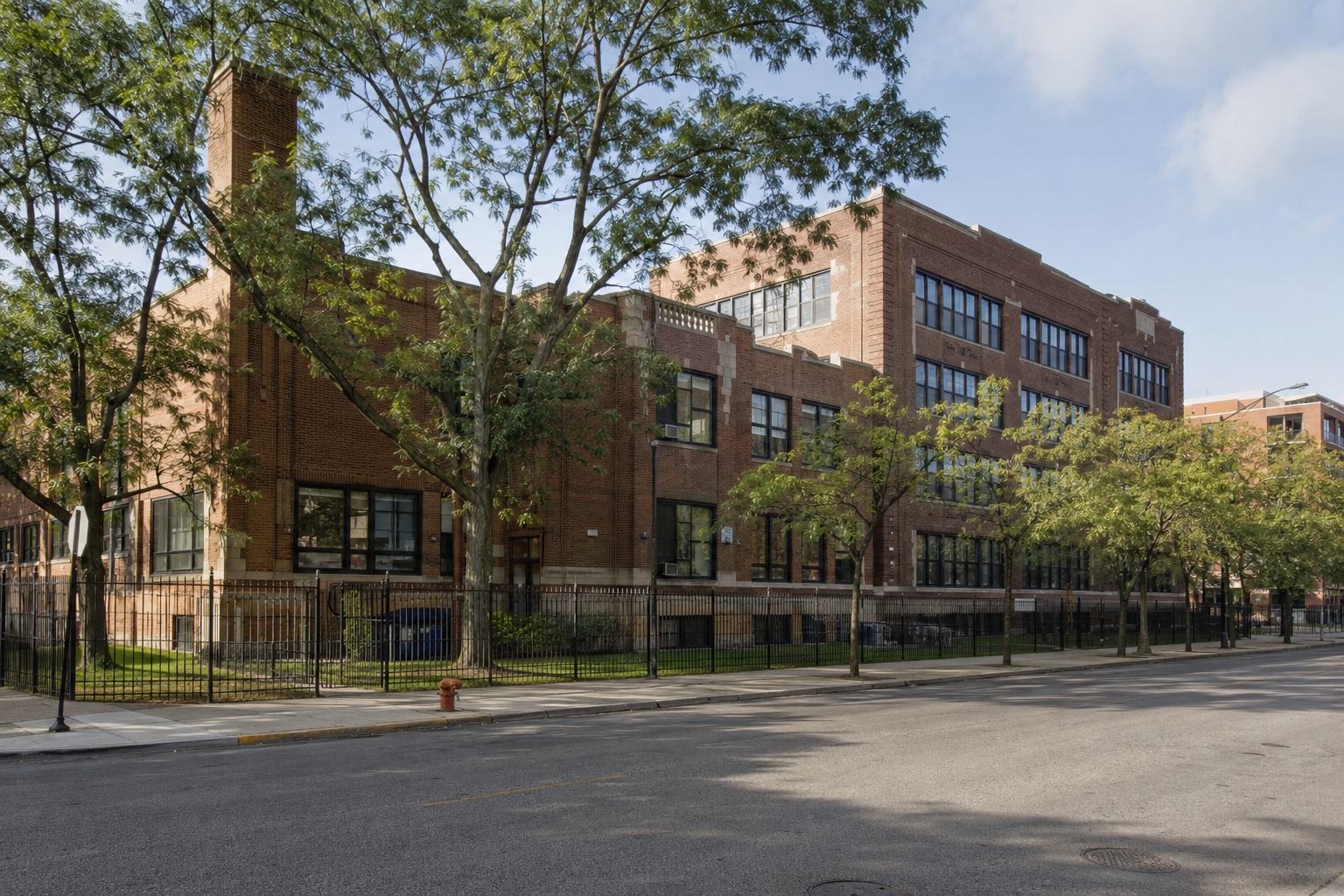
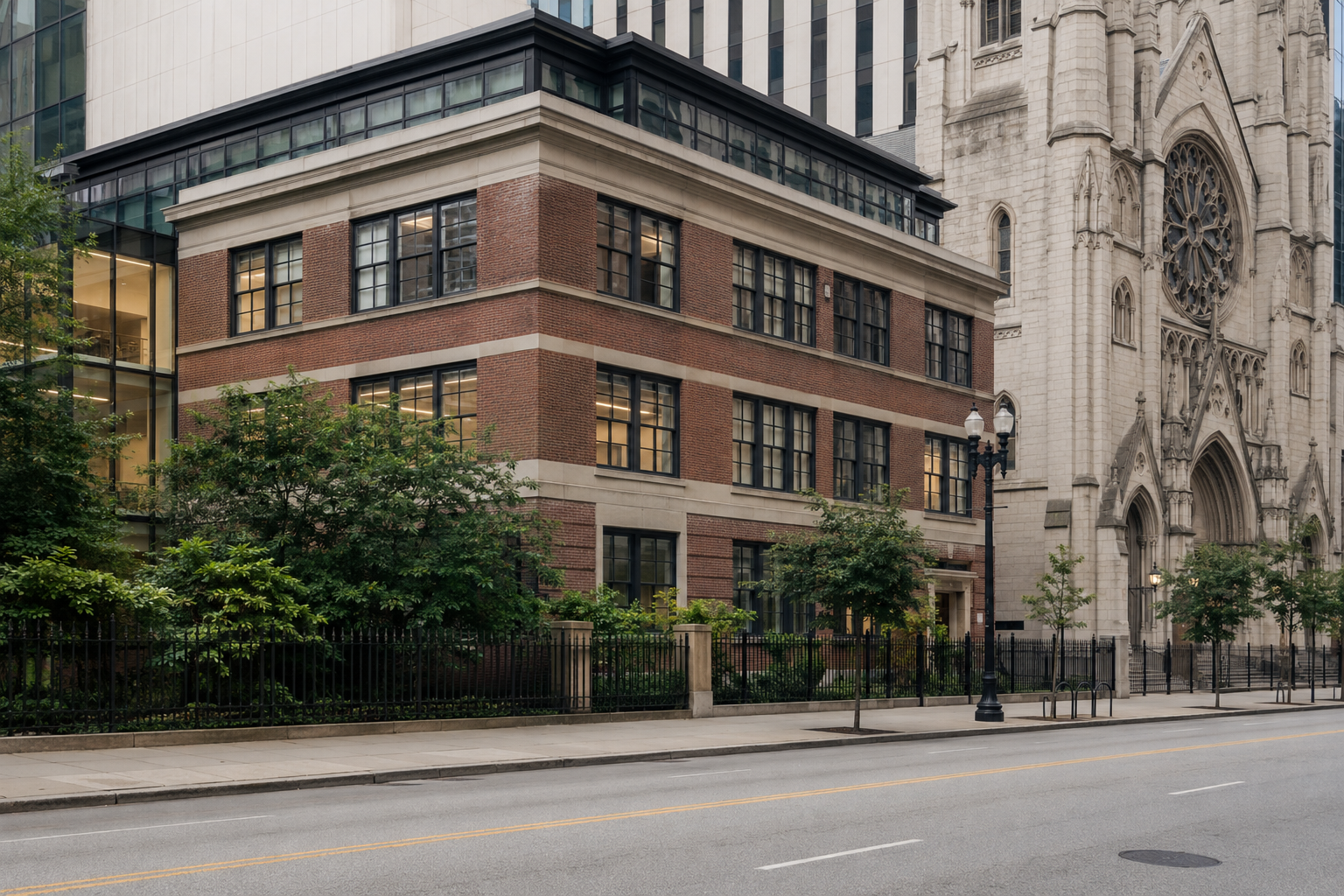

River North is served by a single school district, Chicago Public Schools, formally City of Chicago School District 299, so there is no district-boundary question here. The honest framing for this neighborhood is simple: River North is not primarily a family market. Its housing stock is overwhelmingly one and two bedroom condominiums in high-rise buildings, and most families who want school catchments and outdoor space choose Lincoln Park, North Center, or the Southport Corridor. That does not mean there are no good options, and buyers with children should know exactly what they are.
Much of River North falls within the attendance area of Ogden International School of Chicago, the same school that serves the Gold Coast, with its kindergarten through grade 4 East Campus at 24 W. Walton Street, grades 5 through 8 at the Jenner Campus on North Cleveland Avenue, and the high school at the West Campus on West Erie Street. Ogden is the only full-continuum preschool to grade 12 public International Baccalaureate school in Illinois and is among the most internationally diverse schools in the district. Its published ratings are mixed rather than strong, with a Niche B and a GreatSchools 5 out of 10 at the high school level, so buyers should read the current figures directly rather than relying on the IB designation alone. Confirm the attendance boundary for a specific address with Chicago Public Schools.
Because River North sits close to the center of the city, it is well placed for schools that admit by application rather than by address. Walter Payton College Prep on North Wells Street, ranked among the strongest public high schools in the country, is a short distance northwest and admits city-wide by test score and tier. Franklin Fine Arts Center in Old Town is a magnet elementary drawing from across the city. Neither is secured by a River North address, and buyers should treat both as possibilities rather than entitlements.
The independent options serving River North families sit mostly just outside it. The Frances Xavier Warde School runs its grades 4 through 8 campus at 751 N. State Street beside Holy Name Cathedral, on the neighborhood's eastern edge, with its younger grades downtown. British International School of Chicago, Catherine Cook School in Old Town, and the Latin School of Chicago in the Gold Coast all draw families from here, and Loyola University Chicago's Water Tower Campus and Northwestern's Chicago campus are both within walking distance for adult students.
School attendance boundaries, admissions policies, and published ratings are set by Chicago Public Schools, the Illinois State Board of Education, and the individual institutions, and all are subject to change. Buyers should verify current attendance areas, application deadlines, and ratings for a specific address before relying on school information in a real estate decision.
Development accelerated with Potter Palmer's mansion in 1882.
Encompasses the historic core alongside the 60611 district.
Consisting of roughly 5,600 households averaging two people.
Historically one of America's wealthiest urban enclaves.
Neighborhood entry point, driven heavily by vintage condominium volume.
The current baseline for standard attached housing stock.
Set in 2017 by the purchase of the top four floors at No. 9 Walton.
The neighborhood's largest single source of high-rise inventory.
With a median asking price currently hovering near $585,000.
The average market pace alongside ~45 monthly closings.
Connected directly to the trail via Oak Street Beach.
Direct access via two CTA train stops and four major bus routes.
Navigating Chicago's Gold Coast luxury real estate market requires unparalleled expertise. Here is what you need to know before we begin.
Ask A QuestionThe honest answer is that the neighborhood median tells you very little, because active listings have ranged from about $189,900 to $6,000,000 at the same time. Redfin reported a median sale price of about $426,750 for the three months ending March 2026, essentially flat year on year at roughly $400 per square foot. Another tracker reported a July 2026 median of $432,000 against an average sale price of $540,621 across roughly 294 listed condominiums, and Zillow's typical value sat in the low-to-mid $300,000s. What actually determines price here is the building, the floor, the exposure, and the view, and what determines total cost is the monthly assessment, which ranges from the low hundreds in older loft conversions to more than $1,000 in full-service towers. Price by building, not by neighborhood.
The Chicago River forms the southern and western edges, and both other sides are genuinely contested. Most descriptions put the northern boundary at Chicago Avenue, though some extend it to Division Street, and the eastern boundary is variously given as Wabash Avenue, State Street, or Michigan Avenue at the Magnificent Mile. River North sits inside the Near North Side, Community Area 8, which it shares with the Gold Coast, Streeterville, and Old Town, so an address here is accurately described as both River North and Near North Side. The practical consequence is that listings on the eastern and northern edges are sometimes marketed as Gold Coast or Streeterville, so check the cross streets rather than the neighborhood label.
On recent data, buyers have more room here than in most Chicago neighborhoods, though the gap has been narrowing. On the latest Redfin reading, for the three months ending March 2026, the median was essentially flat year on year, homes were taking about 71 days to sell, down from 87 a year earlier, and the sale-to-list ratio was about 98.9 percent, meaning the typical home sold slightly below asking. For comparison, several North Side neighborhoods were selling above list in under 40 days over the same period. Two caveats. The picture varies enormously by building, and a well-priced unit in a strong association with healthy reserves can still move quickly. And the direction of travel has been firming, with prices flat rather than falling and days on market shortening, so confirm the current numbers before making a decision either way. Sellers here should expect to price into the market rather than above it.
Five things, in this order. The monthly assessment and what it includes, because the range across the neighborhood is wide enough to change your total cost by hundreds of dollars a month. The reserve study and assessment history, since an association with thin reserves and deferred facade, window, or mechanical work will bill you for it later. Any pending or recently levied special assessment. The rental cap and the current percentage of units rented, which affects both financing and resale. And whether the building is warrantable for conventional financing, since a high investor ratio or ongoing litigation can restrict lending and materially shrink the pool of buyers when you sell. A beautiful unit in a weak building is the most common expensive mistake made in this neighborhood.
It depends entirely on the block, and the difference is large. The area around Hubbard, Clark, Ontario, and Illinois Streets is Chicago's main nightlife district, and a low-floor unit facing those streets will hear queues, valet traffic, and late-night activity on weekends. Move a few streets northwest into the gallery district, west toward Kingsbury Park, or up twenty floors in the same building, and the experience is completely different. This is predictable rather than mysterious, so the practical advice is to visit the specific unit on a Saturday night before making an offer, and to weigh exposure and floor height alongside price when comparing two apparently similar listings.
Bally's has operated a temporary casino inside the landmark Medinah Temple at 600 N. Wabash Avenue since September 2023, with roughly 750 slot machines, 55 table games, and a handful of food and drink outlets. Its permanent $1.7 billion casino, hotel, and entertainment complex is being built in River West, not River North, on the former Chicago Tribune Freedom Center site. That project has been delayed more than once. Legislation extending the temporary license passed in June 2026, moving the Medinah Temple expiry from 9 September 2026 to 9 September 2027, and Bally's is now targeting a spring 2027 opening for the permanent complex. For River North buyers, the practical takeaway is that the temporary casino will remain in the neighborhood into 2027, and that the permanent complex will sit across the river rather than here. Confirm the current position, since this has moved repeatedly.
River North is served by one district, Chicago Public Schools District 299, and it is not primarily a family neighborhood. The housing stock is overwhelmingly one and two bedroom condominiums, and buyers who need school catchments and outdoor space generally look to Lincoln Park, North Center, or the Southport Corridor. That said, much of River North falls in the attendance area of Ogden International School of Chicago, the only full-continuum preschool to grade 12 public International Baccalaureate school in Illinois, whose published ratings are mixed rather than strong. Walter Payton College Prep is nearby but admits city-wide by test and tier rather than by address. The Frances Xavier Warde School sits on the eastern edge beside Holy Name Cathedral. Confirm attendance boundaries with CPS for a specific address.
All three are downtown-adjacent condominium markets and they suit different buyers. The Gold Coast is the most established and most expensive per square foot, built on vintage co-operatives and luxury towers in a landmark district, with Oak Street retail at the door and almost no houses. The West Loop is the newest, built on converted warehouses and new towers, with the highest concentration of Michelin-starred restaurants in the city and the least green space. River North sits between them geographically and in character: the deepest and widest condominium market of the three, the shortest walk to the Loop, the most nightlife, and pricing that currently leans toward buyers. Buyers who want a landmark vintage building choose the Gold Coast, buyers who want a loft and Fulton Market on their doorstep choose the West Loop, and buyers who want choice, walkability, and negotiating room choose River North.
Carrie McCormick has sold Chicago real estate since 1999, has closed more than $3.5 billion in career sales, and lists River North among her core markets. Under her "100 percent Carrie" model clients work directly with her from the first valuation through closing. In a market this building-driven, that matters more than usual. The work is reading associations rather than neighborhoods: comparing reserve studies and assessment histories, knowing which buildings have deferred facade or mechanical work and which have already paid for it, understanding which lines and exposures in a given tower hold value, judging what nightlife proximity does to a specific unit's resale, and pricing against the four or five genuinely comparable sales inside the same building rather than a neighborhood median spanning thirty times its own range. In a softer market that judgment is worth more, not less. She is ranked in the top 1 percent of brokers by the Chicago Association of Realtors, holds the association's Gold and Platinum awards, is the recurring luxury real estate expert on NBC 5 Chicago's Open House Chicago, and works within the Christie's International Real Estate network. Call 312-961-4612.
Carrie McCormick has been selling Chicago real estate since 1999, with more than $3.5 billion in career sales and River North among her core markets. Her practice here spans the whole neighborhood, from timber loft conversions in the gallery district and Marina City's curved towers to riverfront high floors and newer buildings around Montgomery Ward Park. Ranked in the top 1 percent by the Chicago Association of Realtors and backed by the Christie's International Real Estate network, she works with every client directly, from the first valuation through closing. To talk through a purchase, a sale, or an investment purchase, call 312-961-4612 or email carrie@atproperties.com.