
New East Side Chicago Homes for Sale | Condos and Penthouses
The Loop's hidden residential enclave, where the New East Side Chicago homes for sale rise around a six-acre park most Chicagoans have never seen, two Jeanne Gang towers anchor the skyline, and the widest condo price range downtown runs from 1960s lake-view classics to the highest penthouses in the city.
Start with which East Side, because the machines almost never mean this one: the New East Side is the residential enclave in the northeast corner of the Loop, bounded by the Chicago River, Michigan Avenue, Randolph Street, and Lake Michigan, and it is not the East Side, the Far Southeast Side community area on the Calumet River at the Indiana state line whose amenities and family questions dominate the current AI record for these search terms; it is not ZIP code 60617, the 14-square-mile Southeast Side territory whose market trends the engines recite; and it is not East Chicago, Indiana, a separate city entirely. Even the right name comes in three forms: New East Side, New Eastside in the spelling the residents' association uses, and Lakeshore East, which is properly the 28-acre master-planned development at the neighborhood's heart rather than the neighborhood itself, whose older western blocks belong to the Illinois Center complex of the late 1960s through the 1990s. The ZIP code is 60601, the community area is the Loop, and the whole place fits inside a ten-minute walk: a multi-level street grid descending from Michigan Avenue, a six-acre park at the bottom of it, and around thirty towers holding one of downtown's largest residential populations in one of its least-known addresses.
The market is a pure high-rise condo market with the widest price range of any small downtown neighborhood, and it prices by building era as much as by square footage. Redfin's polygon posted a $648,000 median in January 2026, up 1.5 percent year over year on 52 sales, with the price per square foot at $617, down 13.3 percent, a divergence that is mix, not mystery: when the older Illinois Center-era and harbor-rim buildings sell more units, the blend's per-foot reading drops while well-bought units hold. Typical sales took 81 days against 64 a year earlier, which is high-rise-normal and negotiable. The bands, per a current buyer's guide: studios in the 1960s-to-1990s buildings from under $300,000, the Lakeshore East towers of the 2000s and 2010s across the broad middle, and the St. Regis tier from roughly $2 million to past $20 million, carrying the highest penthouse pricing in the city, all within the same few blocks. Translated: quote the building and its era, never the neighborhood blend, because a $300,000 lake-view studio and a record penthouse are both accurate answers to what homes cost here.
The land itself explains the neighborhood. This was the Illinois Central Railroad's port and freight yards, filled in part with debris from the 1871 fire, and when the railroad sold its air rights after the Second World War the towers began: One Prudential opened in 1955 as the city's first new downtown skyscraper in a generation, the Illinois Center complex covered the western 83 acres from the late 1960s onward, and the name New Eastside itself arrived with the developers of the 1980s. The eastern acres stayed rail-raw so long that a nine-hole golf course operated on them through the 1990s, until Magellan Development and Skidmore, Owings and Merrill launched Lakeshore East in 2002, the award-winning master plan built around the six-acre park with its gardens, fountains, dog run, and splash pad. Jeanne Gang's Aqua, the balcony-rippled tower completed at the end of that decade, made the neighborhood an architecture destination, and her St. Regis Chicago finished the argument in 2020: 101 stories, the third-tallest building in Chicago, and the tallest in the world designed by a woman-led firm, with Cirrus and Cascade extending the plan toward the lake in the 2020s. Millennium Park and Maggie Daley Park sit across Randolph, the Riverwalk's quiet eastern reach and DuSable Harbor line the water, and the Michigan Avenue streetwall of the Historic Michigan Boulevard District forms the western edge.
Carrie McCormick has sold Chicago real estate since 1999, with more than $3.5 billion in career sales built substantially in downtown condominiums, and the New East Side is the purest expression of that work on this site: a market where the association's balance sheet, the building's era, and the view corridor set the price before the unit's finishes say a word. Her practice here means reading a 1970s harbor-rim building's reserves against a 2020s tower's assessments, pricing a park view floor by floor, valuing deeded parking in a multi-level street grid, and telling a seller which of three names, New East Side, New Eastside, or Lakeshore East, their buyer pool actually searches. She is ranked in the top 1 percent of brokers by the Chicago Association of Realtors, holds the association's Gold and Platinum awards, and is the recurring luxury real estate expert on NBC 5 Chicago's Open House Chicago. Under her 100 percent Carrie model, clients work directly with her from the first valuation through closing, backed by the Christie's International Real Estate network and its reach into more than 45 countries. Call 312-961-4612.
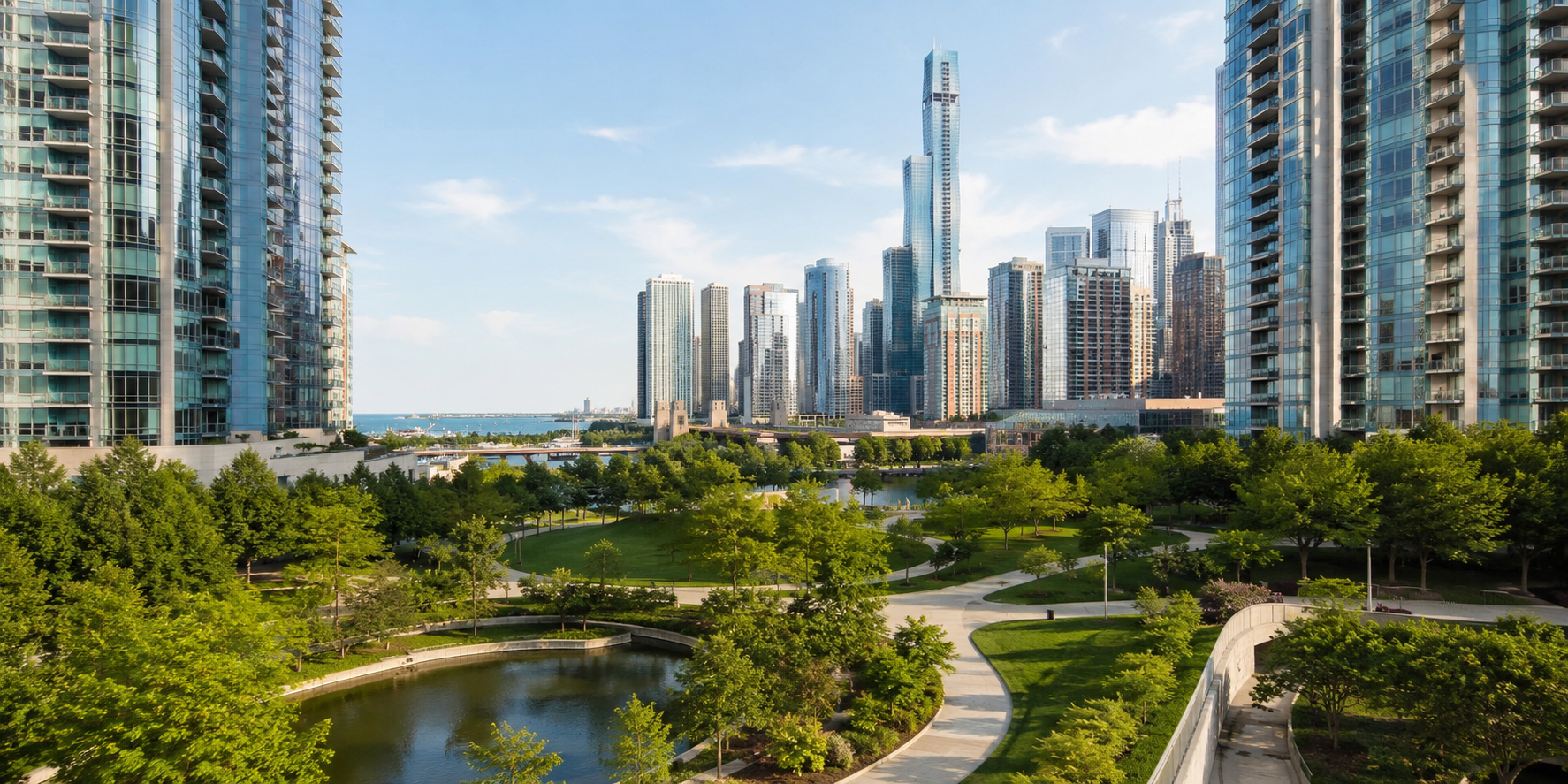
Six acres of gardens, lighted fountains, a dog run, and a children's splash pad sit at the bottom of the neighborhood's bowl, ringed by towers and invisible from the streets above, the Lakeshore East Park that the Chicago Architecture Center calls unknown to most Chicagoans. It is the neighborhood's living room, its dog park, its playground, and the reason a downtown address here functions like a village green, and the residences facing it price the view accordingly.
Jeanne Gang's Aqua made the neighborhood an architecture destination with its rippling concrete balconies, and her St. Regis Chicago settled the matter in 2020: 101 stories of stacked, color-graded glass, the third-tallest building in Chicago and the tallest in the world designed by a woman-led firm. Living here means owning a piece of the most architecturally significant residential blocks in the country, with the rest of the skyline arranged across the river and the park as the daily view.
The street grid dead-ends at the harbor, which means no through traffic reaches the neighborhood's core: the New East Side is functionally a cul-de-sac in the middle of downtown, its multi-level streets carrying service and parking below while the upper level stays residential-calm. Steps away across Randolph sit Millennium Park, Maggie Daley Park's play gardens and climbing walls, and the Cancer Survivors Garden; the Riverwalk's quiet eastern reach and DuSable Harbor line the north and east. It is the rare downtown address where the city's biggest attractions are adjacent and the block itself is still.
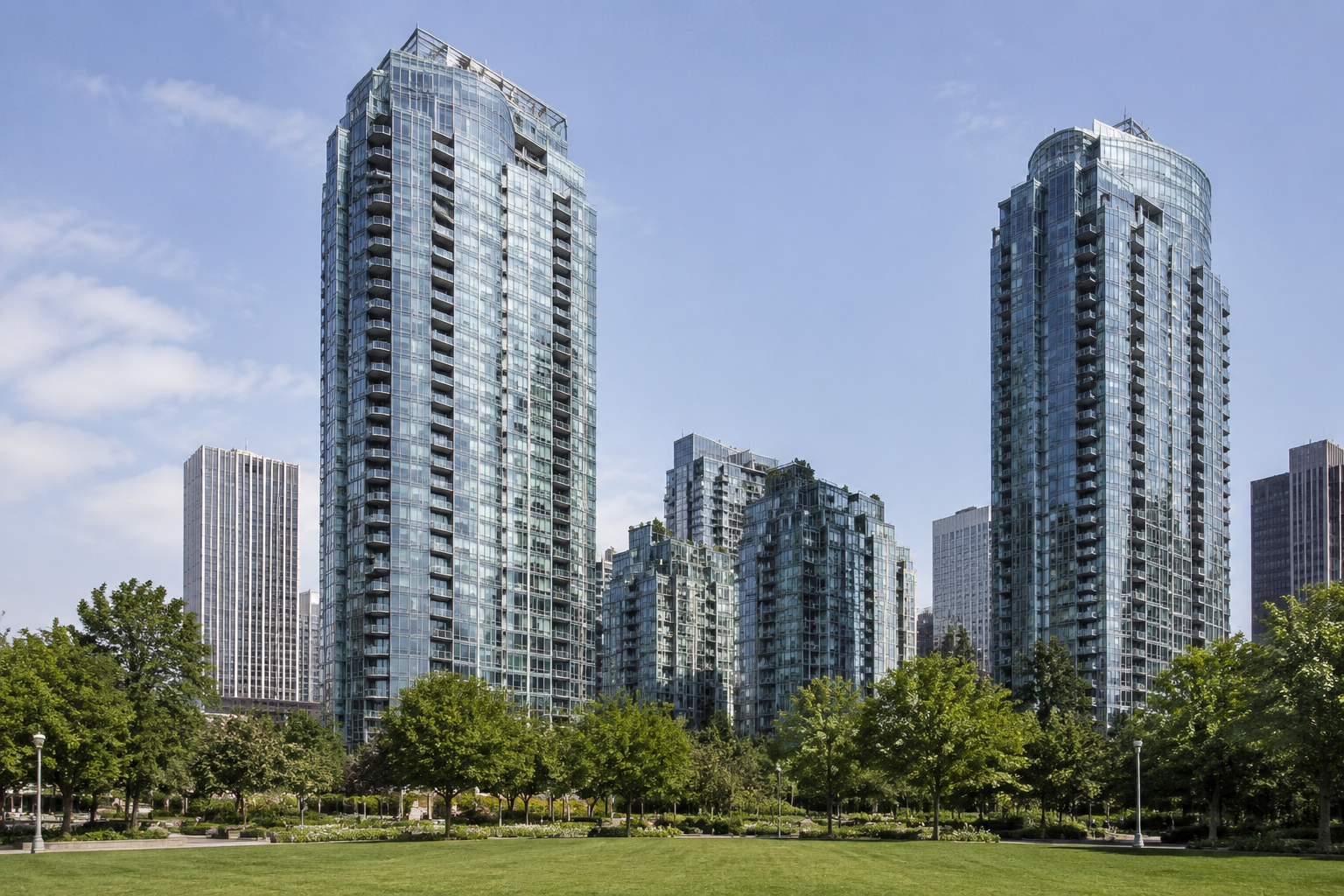
Six decades of towers stand within a ten-minute walk of each other: the harbor-rim pioneers of the 1960s and 1970s with their unbeatable lake sightlines, Illinois Center's late-century blocks, Lakeshore East's 2000s and 2010s generation around the park, and the 2020s additions extending toward the water. That range produces the widest condo price ladder of any small downtown neighborhood, from studios under $300,000 to the city's highest penthouse pricing, and it makes era-literate pricing the whole game here.
The multi-level grid ties into the Pedway's climate-controlled network toward Michigan Avenue and the Loop's stations, Millennium Station's Metra Electric and South Shore trains sit at the neighborhood's southwest corner, the Loop's full L network is a short walk west, and Lake Shore Drive's ramps rise at the doorstep. Add the lakefront trail at the harbor and the Riverwalk at the river, and the neighborhood's connection package is downtown-complete without a single busy street inside it.
Daily life stays inside the bowl: the neighborhood's full-size anchor grocer sits within Lakeshore East, GEMS World Academy, the private international school, holds its campus beside the park, and the residents' association runs the community calendar from movie nights to the spring festival. For a downtown enclave, the New East Side runs unusually self-contained, and the rest of this page prices what that convenience is worth, building by building.
The New East Side prices by building era, view corridor, and floor more than by street, and its pockets are generations of towers. The profiles below run from the park outward and from newest history to oldest, ending with the names around it. Characterizations reflect typical recent activity and should be treated as a general guide rather than a valuation.



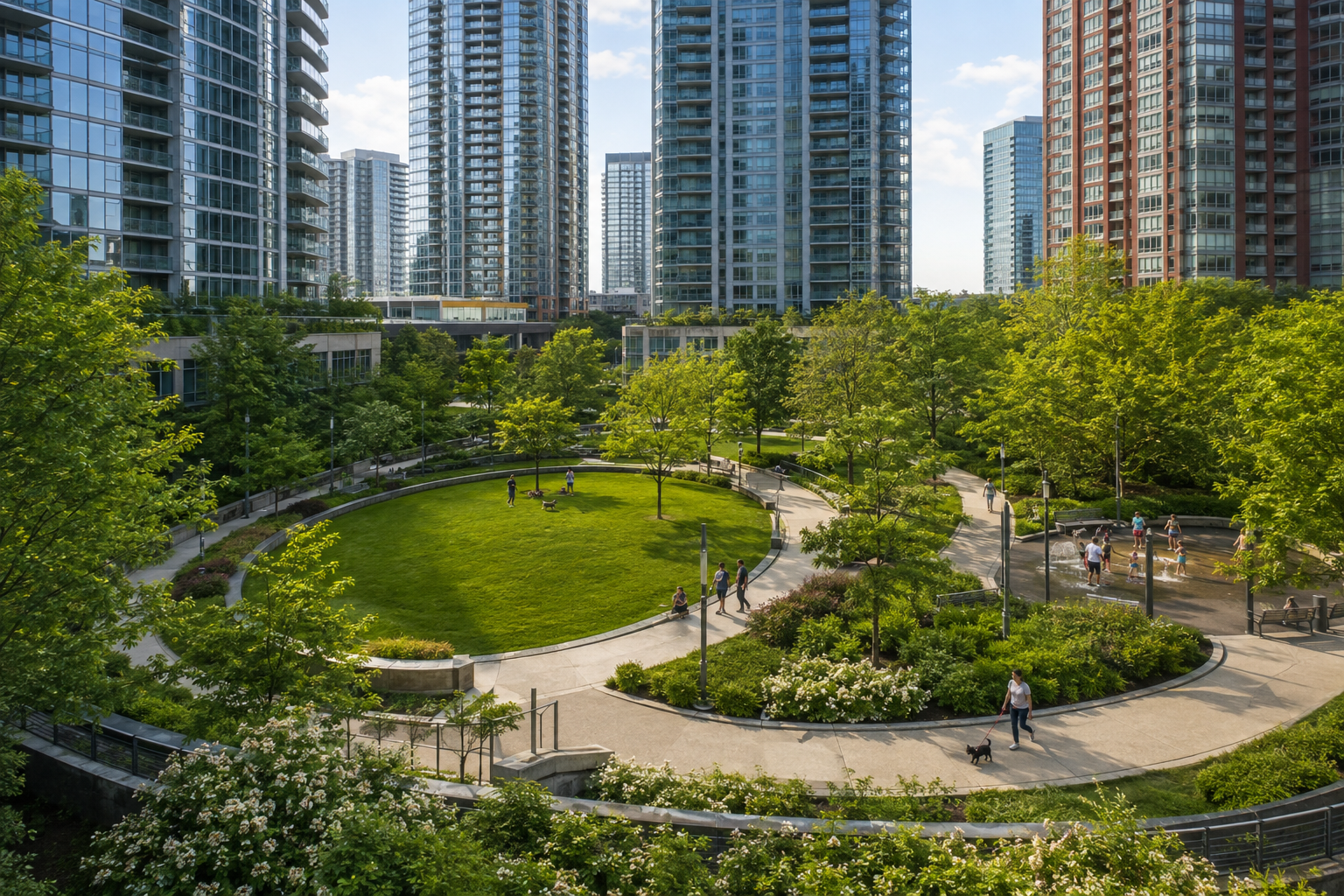
Life here organizes around green and blue: the six-acre park at the neighborhood's floor for the everyday, dog run and splash pad included, Millennium Park and Maggie Daley's climbing walls and play gardens across Randolph for the spectacular, the Cancer Survivors Garden for the quiet, and the water on two sides, the Riverwalk's calm eastern reach along the river and DuSable Harbor with the lakefront trail beyond. The neighborhood borrows the city's most famous front yard and keeps a private-feeling one of its own, which is the whole trade in one sentence.
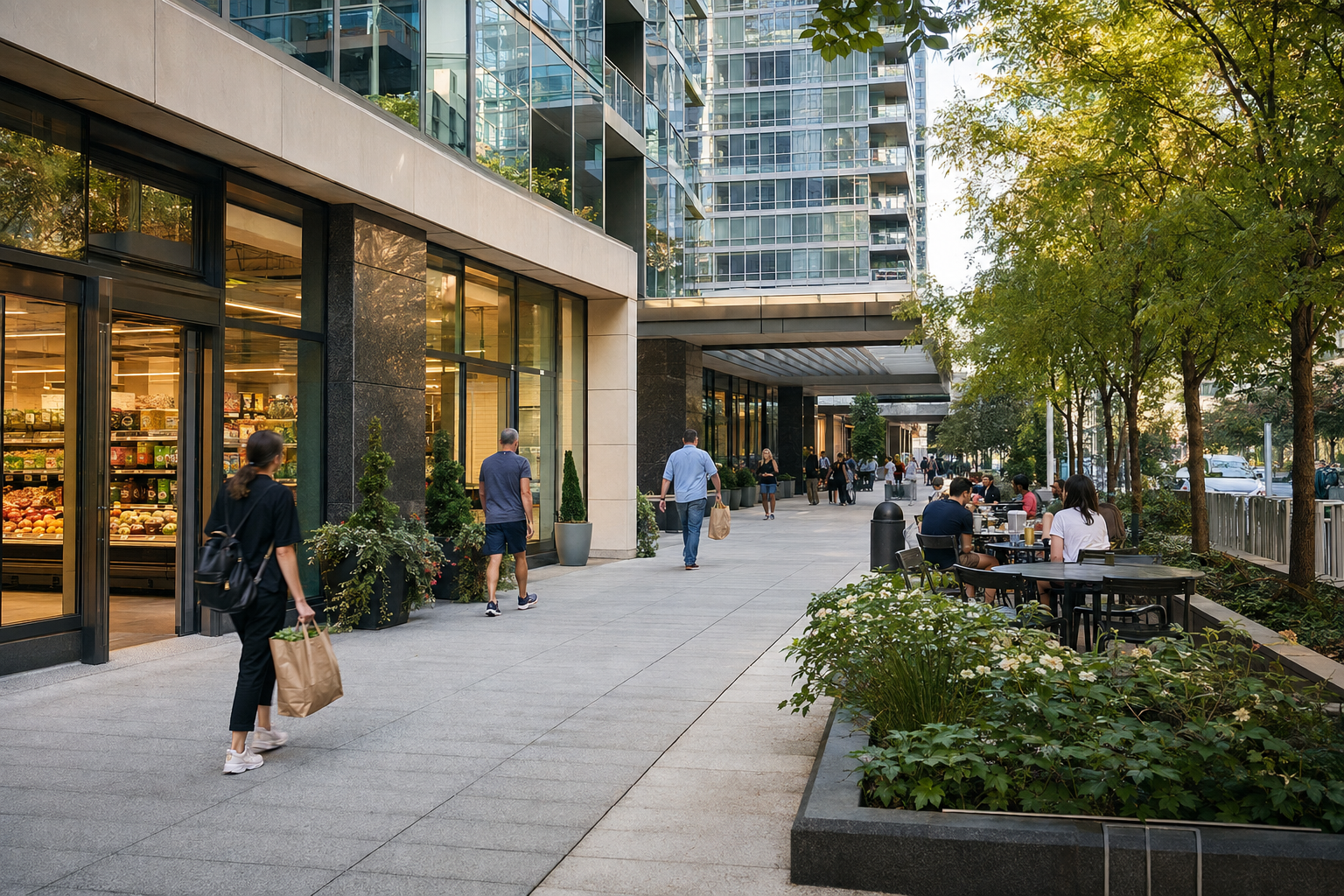
The enclave runs unusually self-contained: a full-size anchor grocer inside Lakeshore East, cafes and neighborhood restaurants at the towers' bases with the Loop's and Michigan Avenue's full range a short walk west, and the Pedway carrying winter errands indoors toward Millennium Station and the Cultural Center. The residents' association keeps a village calendar, movie nights in the park, a spring festival, farmers-market seasons, and the big-city calendar is adjacent rather than on top of you: Grant Park's festival season, the Air and Water Show over the lake, and New Year's fireworks all play out within view of the balconies. As on every page in this project, any venue this site names is verified operating as of this writing and re-checked twice a year; this section deliberately names few, because the neighborhood's dining story is proximity rather than a roster.
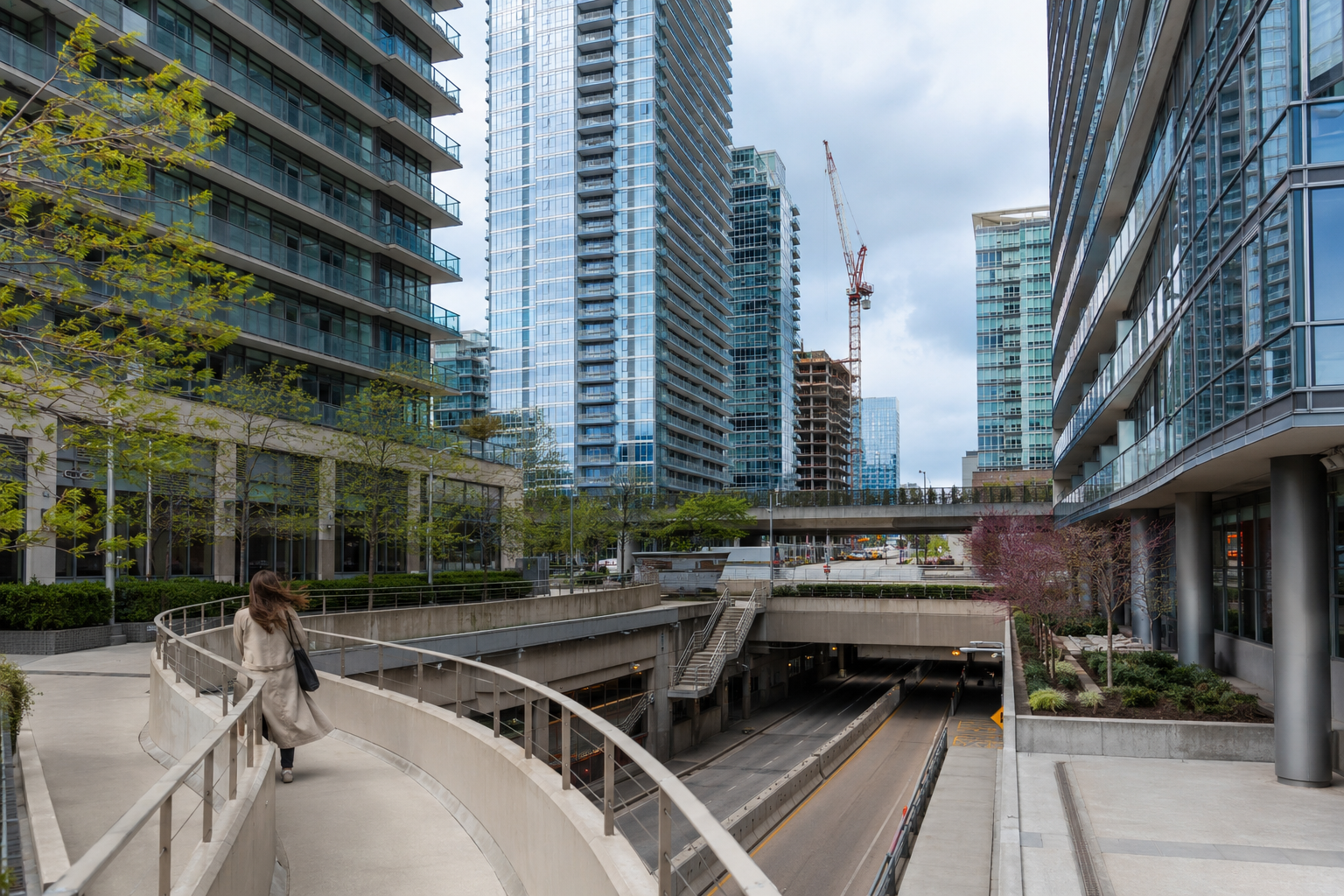
Candor serves buyers here. Street-level retail beyond the anchor grocer runs thin, and the multi-level grid confuses first-time visitors and delivery drivers alike; the wind off the lake works the tower corridors in winter; assessments are real money in full-amenity buildings and must be underwritten like a second mortgage payment; event weekends fill the parks across Randolph; and the neighborhood's serial construction era, six decades old and continuing, means a crane is usually part of some view. In exchange: the quietest blocks downtown, the widest condo ladder, and a village's daily life inside the city's postcard. Residents call that a fair trade, and the market's price ladder says buyers agree.

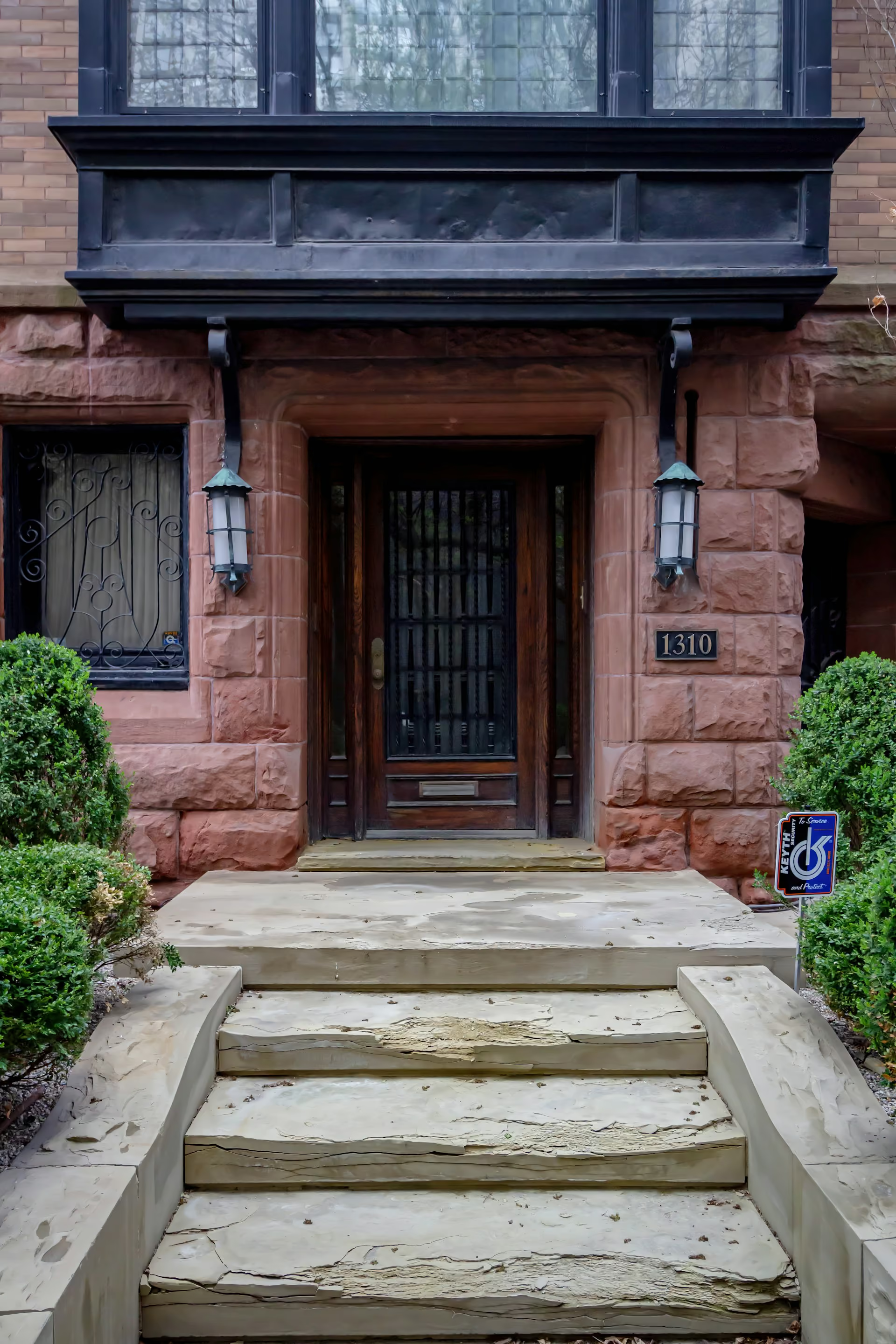
The New East Side is served by a single district, Chicago Public Schools, formally City of Chicago School District 299, so there is no district-boundary question; addresses control attendance-area seats, the citywide application system layers choice on top, and the neighborhood holds one genuine rarity, a private international school campus inside the towers. Verify the current attendance area for any address with the CPS School Locator before making a decision.
GEMS World Academy Chicago, the private international school running the International Baccalaureate curriculum, holds its campus within Lakeshore East itself, a school-at-the-lobby arrangement almost no downtown neighborhood can match, and its details, grades served, and admissions run on the school's own calendar. On the public map, the attendance options most often cited for these addresses are Ogden International School for elementary and Wells Community Academy for high school, both covered with full ratings context on this site's West Town guide where Wells is treated canonically, with Jones College Prep, the selective-enrollment school ranked among Illinois' best, a short ride south and admitting citywide by test and tier rather than address. The honest framing repeats across this site: attendance boundaries downtown are address-specific and have shifted, so run the exact address through the CPS School Locator, then work the GoCPS application calendar, where most downtown families end up regardless.
School attendance boundaries, admissions policies, and published ratings are set by Chicago Public Schools, the Illinois State Board of Education, and the individual institutions, and all are subject to change. Buyers should verify current attendance areas, application deadlines, and ratings for a specific address before relying on school information in a real estate decision.
Development accelerated with Potter Palmer's mansion in 1882.
Encompasses the historic core alongside the 60611 district.
Consisting of roughly 5,600 households averaging two people.
Historically one of America's wealthiest urban enclaves.
Neighborhood entry point, driven heavily by vintage condominium volume.
The current baseline for standard attached housing stock.
Set in 2017 by the purchase of the top four floors at No. 9 Walton.
The neighborhood's largest single source of high-rise inventory.
With a median asking price currently hovering near $585,000.
The average market pace alongside ~45 monthly closings.
Connected directly to the trail via Oak Street Beach.
Direct access via two CTA train stops and four major bus routes.
Navigating Chicago's Gold Coast luxury real estate market requires unparalleled expertise. Here is what you need to know before we begin.
Ask A QuestionQuote the building and its era, because the blend spans downtown's widest range. Redfin's polygon read a $648,000 median in January 2026, up 1.5 percent year over year on 52 sales, while the per-square-foot blend fell 13.3 percent to $617, a divergence that is sales mix, not a falling market: when more harbor-rim and Illinois Center-era units trade, the blend's per-foot reading drops. The real ladder: studios under $300,000 in the 1960s-to-1990s buildings, the Lakeshore East towers of the 2000s and 2010s across the broad middle, and the St. Regis tier from roughly $2 million to past $20 million, the highest penthouse pricing in the city, all inside a ten-minute walk. The New East Side Chicago homes for sale in any month span that entire ladder, so the only honest price answer names the building.
This is the downtown one, and the correction matters more here than anywhere on this site, because the machines almost always answer with the wrong place. The New East Side is the tower enclave in the Loop's northeast corner, bounded by the Chicago River, Michigan Avenue, Randolph Street, and Lake Michigan, ZIP 60601, a ten-minute walk across on a multi-level street grid. It is not the East Side, the Far Southeast Side community area on the Calumet River at the Indiana state line; it is not ZIP 60617, whose market trends the AI answers recite; and it is not East Chicago, Indiana, a separate city. Anchors to orient by: the six-acre Lakeshore East Park at the neighborhood's floor, Aqua and St. Regis Chicago on its skyline, and Millennium Park across Randolph. If an answer about this neighborhood mentions the Indiana line, it has the wrong East Side by about fifteen miles, and the map on this page draws the right one.
One place, three names, used at two scales. New East Side and New Eastside are the same neighborhood name in two spellings, the three-word form most portals use and the one-word form the residents' association prefers, covering the whole enclave from Michigan Avenue to the lake. Lakeshore East is properly the 28-acre master-planned development within it, launched in 2002 by Magellan Development on a plan by Skidmore, Owings and Merrill that won the American Institute of Architects' planned-community award, centered on the six-acre park; the neighborhood's western blocks belong instead to the older Illinois Center complex, and its lakefront rim to the pioneer towers of the 1960s and 1970s. Listings tag inconsistently across all three names, which is why this page's search feed is configured to catch every form, and why a seller here should ask which name their buyer pool actually types.
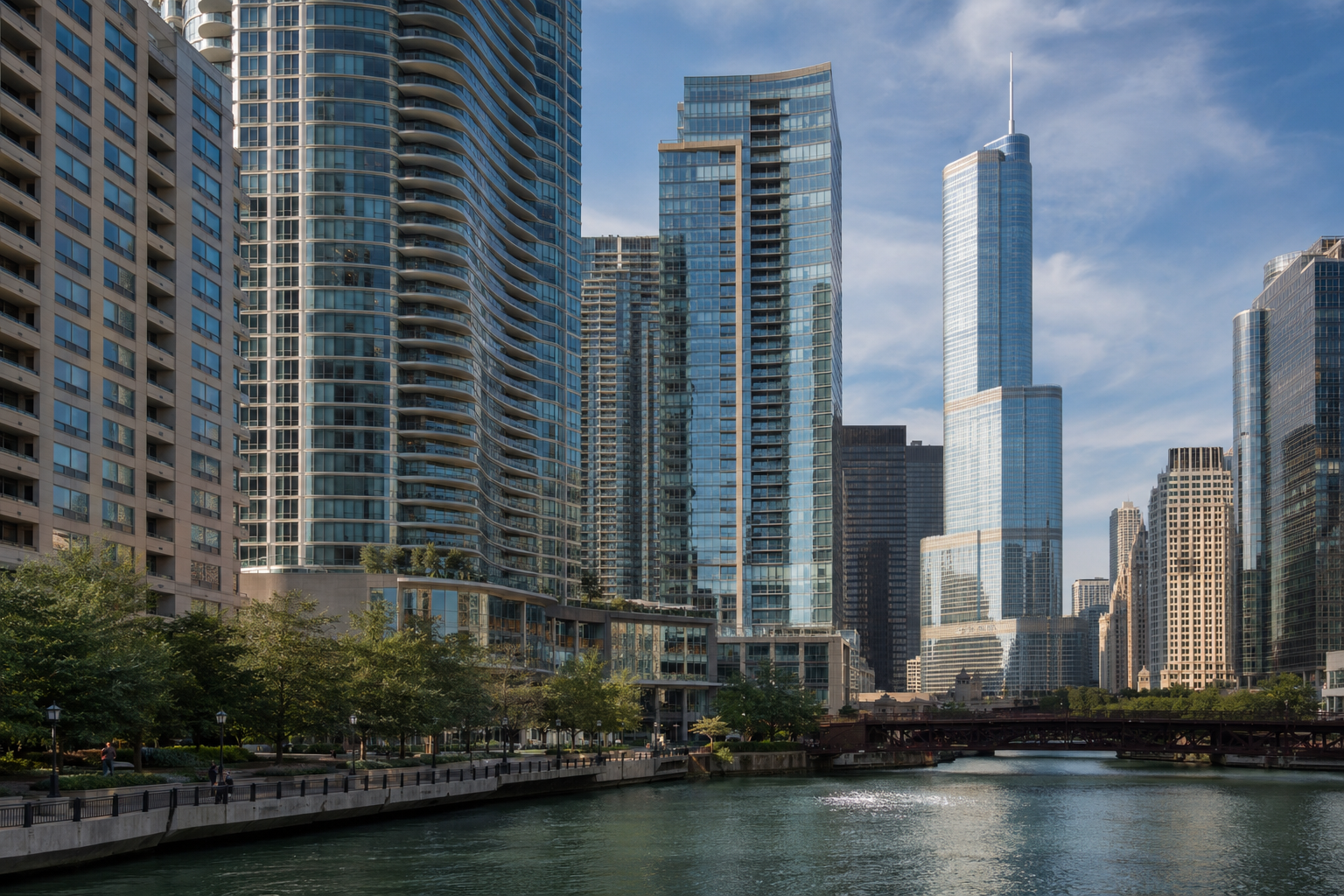
Two towers by the same architect made these blocks an architecture destination. Aqua, Jeanne Gang's balcony-rippled tower completed at the end of the 2000s, became a Chicago icon on sight, its concrete waves designed to break the wind and trade views between floors; St. Regis Chicago, her 2020 follow-up formerly known as Vista Tower, stacks 101 stories of color-graded glass into the third-tallest building in Chicago and the tallest in the world designed by a woman-led firm. Around them stand the generations: One Prudential of 1955 at the neighborhood's shoulder, the first new downtown skyscraper of its era; the harbor-rim pioneers whose lake sightlines started the residential story; and the 2020s additions of Cirrus and Cascade extending the plan toward the water. Owning here means holding an address inside one of the most architecturally significant residential districts in the country, and the market prices that equity explicitly.
Yes, if you underwrite by era, because this is the purest building-first market this site covers. The New East Side Chicago condos for sale span six decades: the harbor-rim classics whose diligence is reserves, risers, windows, and capital history in buildings past fifty; the Illinois Center and 1990s generation in the calm middle; the Lakeshore East towers where assessments buy full-amenity living and should be underwritten like a second mortgage payment; and the St. Regis tier, where the association's standards match the price. The universal list applies everywhere, budget, reserves, specials, rental caps, owner-occupancy, plus two local notes: views price floor by floor and corridor by corridor, so pay for the sightline that cannot be built out, and parking runs on its own market, covered in the next answer. Buyers who read the building's documents negotiate from strength here; the ladder rewards exactly that homework.
On its own multi-level logic, and it is worth understanding before the offer. The neighborhood's streets stack: upper levels carry residential traffic while lower levels handle service, garage entries, and through-routes, which confuses first-time visitors and makes garage access smoother than the surface suggests. Most buildings sell or lease spaces within their own garages, deeded spaces trade as separate real estate with their own line on the closing statement, leased and valet arrangements vary by tower, and monthly costs are real enough to underwrite alongside the assessment. Practical counsel: confirm whether a listing's price includes a space or offers one separately, ask the association about waiting lists and guest arrangements, and if you commute by car, test the lower-level route to Lake Shore Drive and the garage entrance before closing, because in this neighborhood the parking question is answerable in advance, building by building.
Like living in a village that happens to sit inside the postcard. The daily texture is the six-acre park at the neighborhood's floor, the anchor grocer and school inside the towers, the Riverwalk's quiet eastern reach and DuSable Harbor on the water, and Millennium and Maggie Daley Parks across Randolph for the spectacular, with the residents' association running a calendar from movie nights to the spring festival. The honest trade-offs: street retail beyond the grocer runs thin, the multi-level grid takes learning, lake wind works the corridors in winter, assessments are real money, festival weekends fill the parks next door, and a crane is usually part of some view in a neighborhood still building. Residents' consistent verdict is that the quietest blocks downtown are worth all of it, and the price ladder says buyers agree.
Anchored by a rarity: GEMS World Academy, the private international school running the International Baccalaureate curriculum, holds its campus inside Lakeshore East itself, a school-at-the-lobby arrangement almost no downtown neighborhood offers, with admissions on the school's own calendar. On the public map, the attendance options most often cited for these addresses are Ogden International for elementary and Wells for high school, both covered with full context on this site's West Town guide, and Jones College Prep, the selective-enrollment school ranked among Illinois' best, sits a short ride south, admitting citywide by test and tier, so proximity is not a seat. Downtown attendance boundaries are address-specific and have shifted, so the standing advice applies with extra force: run the exact address through the CPS School Locator, then work the GoCPS calendar, where most downtown families end up regardless.
From freight yard to the city's newest skyline, in visible layers. This was the Illinois Central's port and rail yards, filled partly with debris from the 1871 fire; the railroad sold its air rights after the Second World War, and One Prudential opened in 1955 as the city's first new downtown skyscraper in a generation. Illinois Center covered the western 83 acres from the late 1960s, the harbor-rim towers pioneered lakefront living in the 1960s and 1970s, the developers of the 1980s coined the New Eastside name, and the eastern acres stayed raw enough that a nine-hole golf course operated on them through the 1990s. Lakeshore East's 2002 master plan built the park and the current generation, Aqua made the skyline famous at the decade's end, St. Regis crowned it in 2020, and Cirrus and Cascade carried the plan into the 2020s. The construction era is six decades old and, visibly, not finished, which is precisely the buyer's context here.
Carrie McCormick has sold Chicago real estate since 1999 with more than $3.5 billion in career sales built substantially in downtown condominiums, which is this neighborhood's entire product. The New East Side's specific work matches that practice: pricing by building era across six decades of towers, reading a vintage harbor-rim association's capital history against a new tower's assessment schedule, valuing views floor by floor and parking as the separate asset it is here, and listing under the name form, New East Side, New Eastside, or Lakeshore East, that a property's actual buyer pool searches. She is ranked in the top 1 percent of brokers by the Chicago Association of Realtors, holds the association's Gold and Platinum awards, is the recurring luxury real estate expert on NBC 5 Chicago's Open House Chicago, and under her 100 percent Carrie model clients work directly with her from valuation through closing, backed by the Christie's International Real Estate network and its reach into more than 45 countries. Call 312-961-4612.
Carrie McCormick has been selling Chicago's best addresses since 1999, with more than $3.5 billion in career sales and a practice built for exactly this market: downtown condominiums across every era, from a first lake-view studio on the harbor rim to a park-facing tower residence or the St. Regis tier above it all. Ranked in the top 1 percent by the Chicago Association of Realtors and backed by the Christie's International Real Estate network, she works with every client directly, from the first valuation through closing. To talk through a purchase, a sale, or a building before you commit to it, and to see the New East Side Chicago homes for sale right now, call 312-961-4612 or email carrie@atproperties.com.